From the above table of data, the offset and slope coefficients to be entered during the C-STAR
calibration procedure must be calculated by the operator. This can be done using the “Interpolate” tool
distributed with the IDRONAUT ITERM program or by using the probe calibration procedure.
Selecting the C-STAR sensor from the list of sensors, the following calibration procedure arises:
Do you already know 'SLOPE & OFFSET' coefficients?:No
The operator can decide to enter the calibration coefficients received with the probe or to let the probe
calculate new coefficients using the table calculated as above described.
Answering <YES>, the following messages appear in sequence:
Offset = 0.0 Slope = 1.0
The operator must enter the offset and slope coefficients, while answering <NO> the following message
appears:
Number of calibration points:0 enter new value< 2
The operator must answer using the tabled data:
Sample value (units)
Sample reading (bit)
The above questions about the units and bit (ADC Counts) are repeated for the number of “Calibration
points” entered. Afterwards, the probe shows the result of the linear interpolation:
Tr% = a + bx
offset = 0.0
slope = 1.0
r correlation coefficient = 1.0
c % of variability = 100%
The operator can now confirm or modify the offset and slope coefficients.
Offset = 0.0 Slope = 1.0
In the end, the list of sensors appears again.
5.6.4 WETLabs - ECO Triplet Sensor
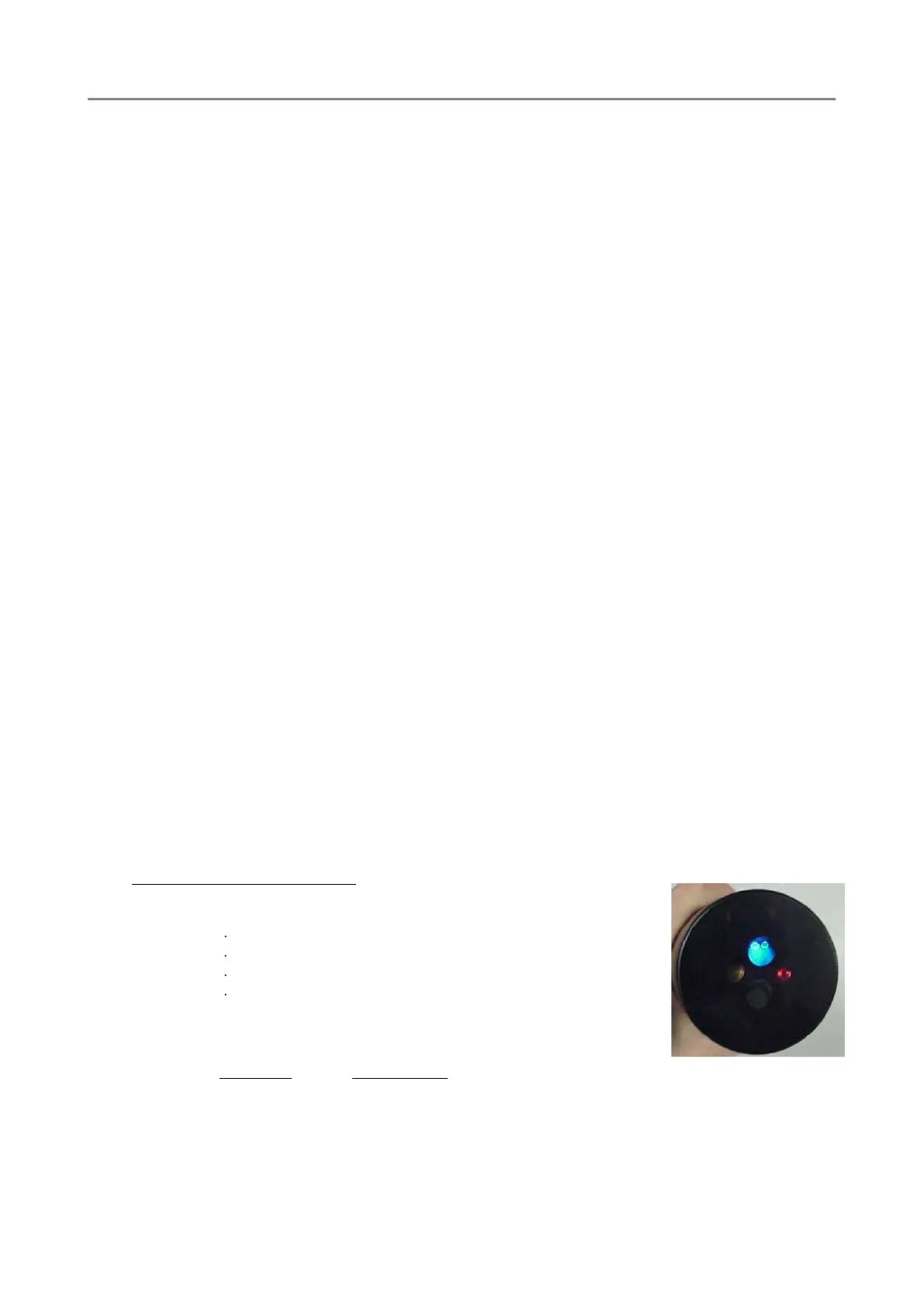
WETLabs offers the custom ECO Triplet as a three-sensor instrument that can
be configured for a variety of measurements:
Three scattering measurements.
Two scattering and one fluorescence measurements.
Three fluorescence measurements.
Two fluorescence and one scattering measurements.
Available measurement options:
Scattering Fluorescence
Blue Chlorophyll
Green CDOM (limited to one CDOM channel)
Red Uranine (fluorescein)
Phycoerythrin, phycocyanin
RhodaminePhycoerythrin, phycocyanin
Rhodamine


 To Next Page