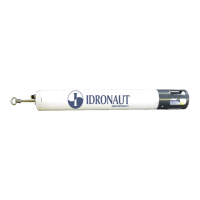
❖ IDRONAUT – Blue Cap Dissolved Oxygen sensor.
❖ WET Labs - C-Star Transmissometer and ECO single/three channel Fluorometer.
❖ CHELSEA - Unilux and Trilux Fluorometers.
❖ SEAPOINT - Fluorometers and Turbidity Meter.
❖ TURNER DESIGNS – Cyclops-7 Fluorometers.
❖ D & A INSTRUMENT COMPANY - OBS-3 Sensor.
❖ LI-COR - LI-192SA Underwater and LI-193SA Spherical Underwater Quantum sensors.
❖ BIOSPHERICAL INSTRUMENTS - QSP-2200 – QSP-2300 Quantum Scalar PAR Sensor.
Other equipment or sensors can be interfaced upon request.
1.2 SAMPLING MODES
The probe is microprocessor-controlled and can be programmed to acquire and process data by various
methods. Processed or raw data can be either transmitted in real time or stored inside the instrument.
Data acquisition methods includes:
➢ Pressure. Data is sampled at regular pressure intervals. Multiple profiles can be obtained by
switching the probe ON and OFF.
➢ Timed. The probe collects a series of samples and then sleeps for the configured time interval
before waking up again and repeating the acquisitions. Time interval can be configured from 5s
up to 1 day. Battery power is conserved while the probe is in sleep mode.
➢ Conditional. Data is sampled at configurable sampling rates starting when the selected parameter
overcomes the configured boundary. Sampling continues until the selected parameter falls below
the configured boundary. Whenever the acquisition cycle starts, a configurable sampling rate
0.1..28Hz is used. Monitoring of the selected parameter occurs at the configurable interval
between 5s up to 1 day.
➢ Continuous. Data is sampled at configurable sampling rates starting when the operator switches
on the probe. Sampling continues until the probe is switched off. Multiple cycles can be obtained
by switching the CTD ON and OFF.
➢ Burst. Burst sampling carried out at configured intervals: 5s up 1 day.
➢ Real-time. Data is sent to the control system at the chose sampling rates.
The slender profile of the probe and the pressure-compensated sensor suite permit operation in either
high speed profiling or in fixed depth monitoring applications to full ocean depths.
1.3 REAL-TIME COMMUNICATIONS
The OCEAN SEVEN 310 multi-parameter probe communicates with a computer via a standard RS232C
interface. Real-time data can be acquired by means of the REDAS-5 Windows software. An optional
RS485 interface overcomes the limitation of the RS232C cable maximum length (200 m) and allows the
probe to transmit data through distances up to 1000 m. The communication speed is user selectable
among: 9600, 19200, 38400 and 115200 (38400 default). The probe can also be equipped with the
IDRONAUT data telemetry, which overcomes the cable limitations and allows the real-time
communication with the probe through the standard oceanographic coaxial cables. It is important to
mention that the OCEAN SEVEN 310 CTD is insulated with respect to the communicating device,
independently of the kind of interface that is used: RS232C, RS485, telemetry. Insulation guarantees that
the sensors are not affected or disturbed by ground loops or stray currents.


 To Next Page