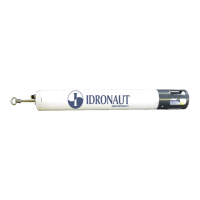
5.6.1 SEAPOINT OEM Turbidity Meter
The SEAPOINT OEM Turbidity Meter is a sensor that measures turbidity by detecting
scattered light from suspended particles in water. Its small size, very low power
consumption, high sensitivity, wide dynamic range and 6000-m depth capability allow this
sensor to be used in most applications where turbidity or suspended particle concentrations
are to be measured. The sensor is also insensitive to ambient light when underwater and
has a very low temperature coefficient. The SEAPOINT Turbidity Meter senses scattered
light from a small volume within 5 centimetres of the sensor windows. Confining the
sensing volume allows the sensor to be calibrated in relatively small water containers
without errors from surface and wall reflections. It also allows the sensor to be used in tight
spaces such as crowded instrumentation packages, pipes and shallow streams.
Each sensor is factory calibrated using formazine Turbidity Standard. The user may also
calibrate the sensor with particles of interest to measure their suspended concentrations.
The SEAPOINT Turbidity Meter is constructed from rugged, corrosion-free materials and
quality surface mount electronic components for durability and high reliability. Some more
information can be found in an application note distributed with the Operator’s Manual.
Once the Turbidity Meter is selected from the list of sensors to be calibrated, the following message and
questions appear:
Turb. sensor calibration
Measuring scale 1, Full scale [>750 FTU]
Current Calibration values
Offset = 0.0
Slope = 1.0
r correlation coefficient = 1
c % of variability = 100
Do you already know 'SLOPE & OFFSET' coefficients ?:No
The operator can decide to enter the calibration coefficients received with the probe or to let the probe
calculate new coefficients using experimental data obtained from the turbidity sensor in the laboratory
(please refer to the dedicated application note).
Answering <YES>, the following messages appear in sequence:
Offset = 0.0 Slope = 1.0
The operator must enter the offset and slope coefficients indicated in the calibration certificate.
By answering <NO>, the following message appears:
Number of calibration points:0 enter new value< 2
Answer with the number of solutions used to calibrate the 750 FTU measuring scale. Now, starting from
the lowest solution and going towards the most concentrated solution, the operator must enter the value
acquired during the laboratory calibration procedure
Sample value (units) Answer with the concentration value of the solution.
Sample reading (bit) Answer with the probe reading.
The above questions about the units and bit (ADC Counts) are repeated for the number of “Calibration
points” entered. Afterwards, the probe shows the result of the linear interpolation:
Turbidity = a + bx


 To Next Page