In the expression
Tr = e
-cx
where x is the path length (10 or 25 cm) of the water volume being measured.
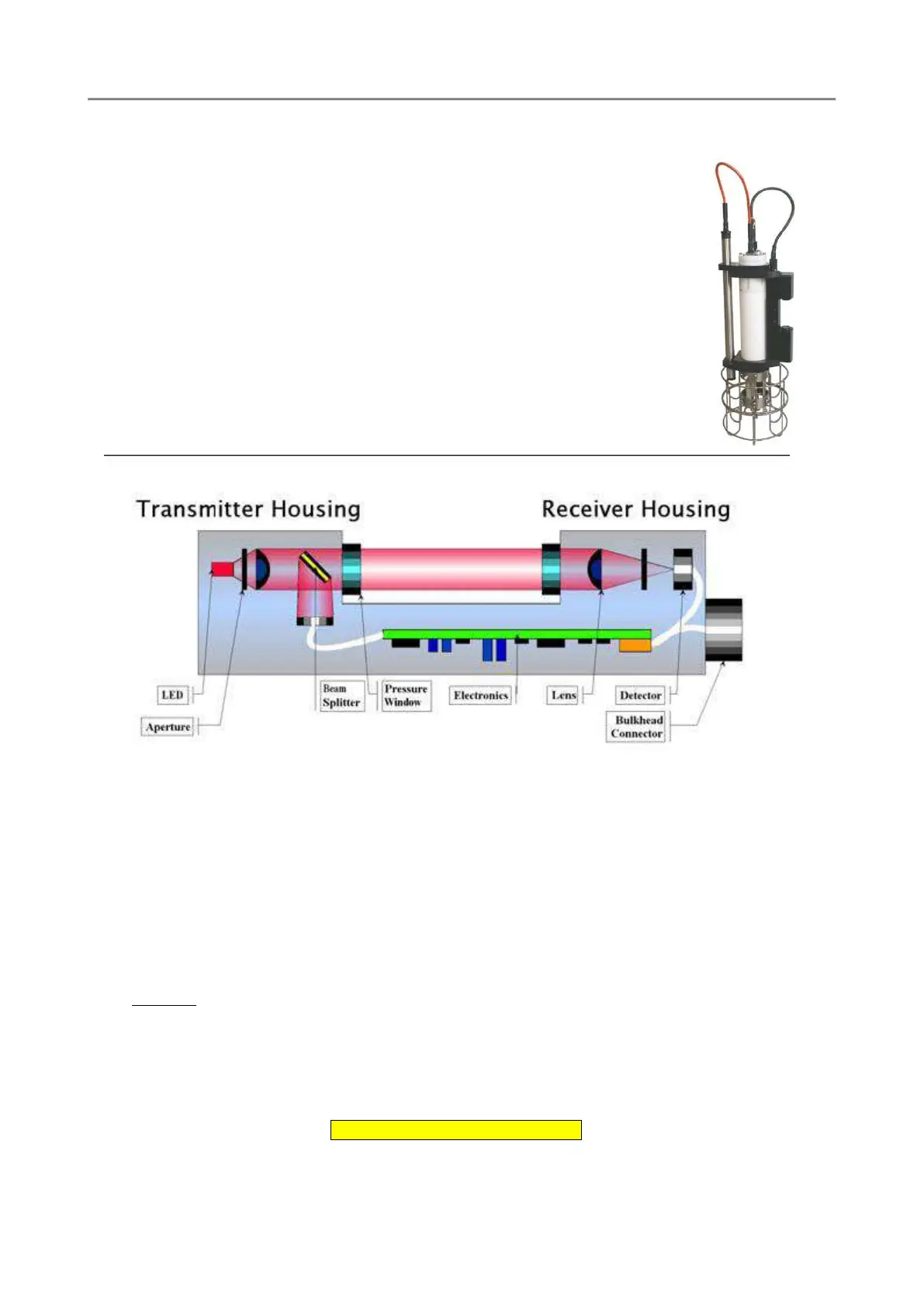
The below figure is a simple description of the C-Star configuration. The
appropriate LED light source (depending on the wavelength) provides light
that is focused and collimated by an aperture and lens that transmit the light
within a given narrow bandwidth. The light passes through a beam splitter so
that a portion of the transmitted light can be monitored by the reference
detector and used in a feedback circuit to account for variations in the LED
source over time as well as changes in the instrument’s internal temperature.
The light enters the sample volume after passing through the first pressure
window, transits the sample volume and enters the receiver optics after passing
through the other pressure window. The light passes through additional
focusing optics and finally strikes a silicon photodiode detector which converts
the amount of received light to a corresponding 0–5 V analogue output signal
which represents the amount of light received.
The
Calibration procedure of the C-Star implies the following preliminary calculation that must be done
using the probe and the C-Star calibration certificate:
Vdark(wetlabs) = 60 mV
VrefWater(wetlabs) = 4786 mV
OS310 Hw scale = 2.00032688
from which the following parameters must be calculated:
Vdark(bit) = (Vdark(wetlabs) / HwScale(Idronaut)) * 52.4288
VrefWater(bit) = (VrefWater(wetlabs) / HwScale(Idronaut)) * 54.4288
Example:
1570.29750 = (60mV / 2.0032688) * 52.4288
125257.3977 = (4786mV / 2.0032688) * 52.4288
The Vdark(bit) and the VrefWater(bit) are therefore associated to the 0 and to the C-STAR full scale
transmittance or 100 %. Thus, a table of experimental data can be generated as follows:
Units (Tr %) OS310 ADC Counts
0 1570.29750
100 125257.3977


 To Next Page