G FOREWORD
The aim of this section is the description of operations needed to operate the OCEAN SEVEN 310 probes
equipped with the IDRONAUT innovative not harmful antifouling device (patent pending).
The antifouling is available only if the OS310
probe has the 100 mm POM housing.
G.1 THE ANTIFOULING DEVICE
The antifouling kit, installed by the measuring
sensors of the Ocean Seven 3xx probes, is
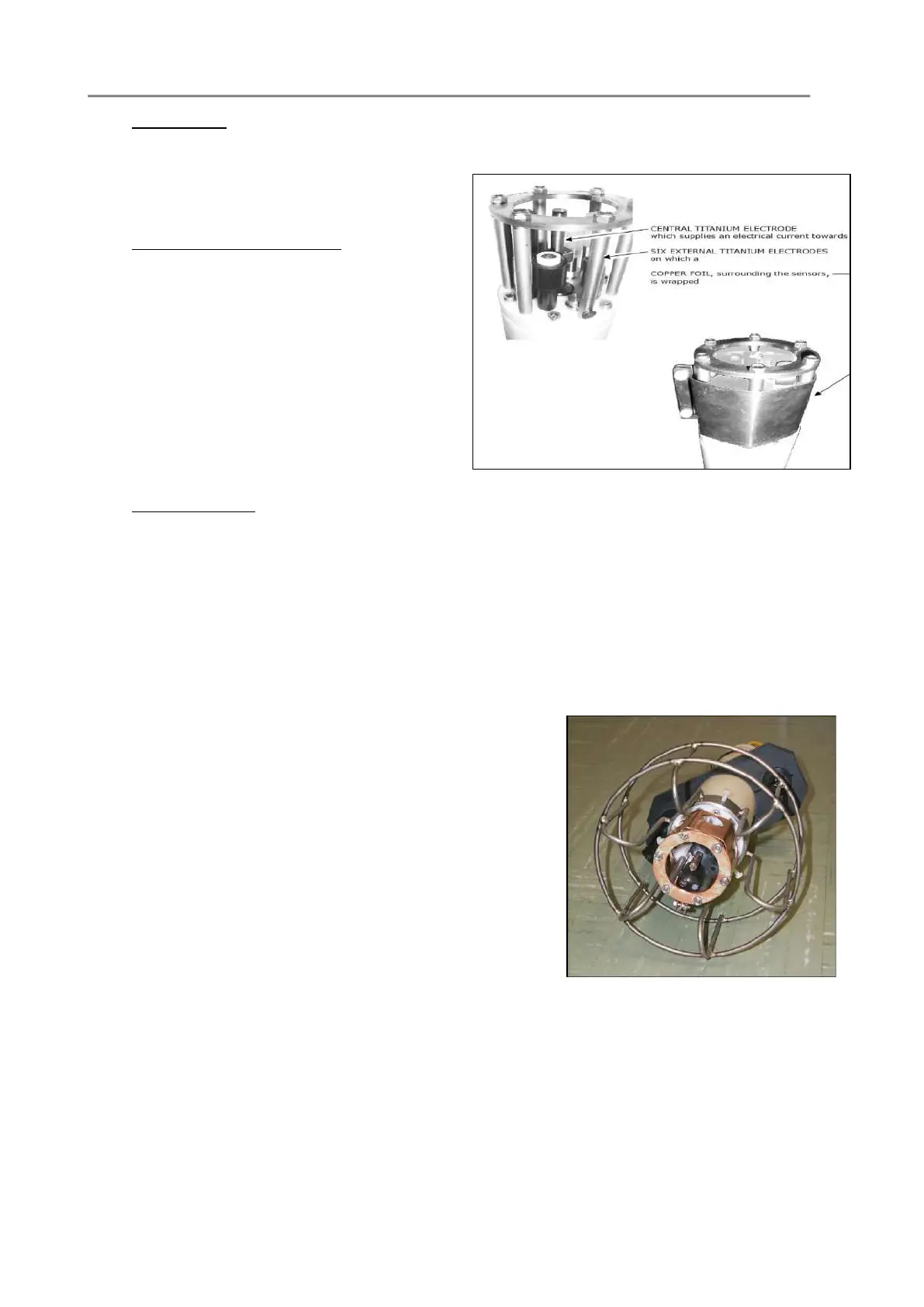
composed of a central titanium electrode which
supplies an electrical current towards six
external titanium electrodes on which a copper
foil (replaceable) surrounding the sensors, can
be wrapped. In addition to chloride formation,
there is copper dissolution in an ionic form by
the sensors. The copper foil has a typical
endurance of more than one year. The sensors
are washed when the probe starts profiling.
G.2 HOW IT WORKS
The fouling probably represents the major difficulty during continuous monitoring of waters and,
although many efforts in research at worldwide level have been dedicated to this problem during the
past decades, a definitive solution is not yet available. Therefore, a compromise must be found each
time according to the specific difficulty met with.
Since our monitoring equipment (Buoy Profiler, OCEAN SEVEN 310) operates to study the
environmental conditions where fishes grow, we have not taken into consideration the antifouling
system based on the slow release of Tributyltin (TBT) oxide or other heavily poisoning chemical
substances. We have then decided to simply use metallic copper to act as an antifouling protection by
the measuring sensors. The picture shows an OCEAN SEVEN 310 probe during the antifouling device
development test with the antifouling device not active after a monitoring of two months.
A foil of copper (1 mm thickness) has been placed around the
sensor cage in such a way that it can be easily replaced with a
new one without damaging the measuring sensors and to also
avoid reducing the flow of water to be measured. The
presence of this simple device has, on average, increased the
time between each cleaning from 1 to 2 weeks only.
This is because the metallic surface of the copper easily
becomes oxidised in a few days and, after that, it loses most
of its activity. In fact, copper is not able any more to dissolve
in an ionic form in the water surrounding the sensors and the
inside of the copper protection.
Therefore, to avoid the copper passivation, we have installed
in the centre of the probe, where the measuring sensors are
placed, a titanium electrode, which “impresses” an electrical current versus the copper foil. In this way
the copper foil, which acts as a flow-measuring chamber, is always clean and so this allows the copper
dissolution in an ionic form. This effect has drastically decreased the formation of fouling by the
measuring sensors.
The current between the titanium and the copper electrodes is applied when the probe is not carrying
out measurements. Vice versa, when the probe starts descending, the current is not applied any more
and the water to be measured flows between the sensors and washes them of the ionic copper previously
dissolved. This improvement considerably increases the “time between cleanings” up to three/four
weeks, depending on the water quality.
To the best of our knowledge, this kind of antifouling system does not appear in the scientific literature and


 To Next Page