IDRONAUT – Brugherio (MB) OCEAN SEVEN 310 CTD 01-2019
IMPORTANT REMARKS
INTERNAL BATTERY REPLACEMENT/RECHARGING
1) To gain access to the battery pack, remove the screws in the probe top cover. However,
before doing this, please ensure to have removed any water droplets around the screw
heads, to prevent them from running down inside the housing.
CTD Top-Cover removal, please follow the instructions in Appendix “A”
2) Rechargeable battery: disconnect the battery pack from the top cover and connect it
to the battery charger.
3) If the probe is not to be used for long periods (some months), remove the internal
battery pack from the probe. This eliminates the possibility of damaging the electronic
circuitry in case of battery leaks because a small amount of energy is drawn from the
internal batteries by the probe electronic circuitry even if OFF. This phenomenon
causes batteries to run down and they may be damaged (leak) in a very long time
SELF-RECORDING USE
➢ The CTD internal Real-Time Clock (RTC) keeper is powered by the CTD main battery. If the
battery run-off energy or is disconnected, the RTC loses date & time. It is mandatory to set
up the CTD date & time or/and check that the CTD date & time are correct before starting
a self-recording data acquisition cycle.
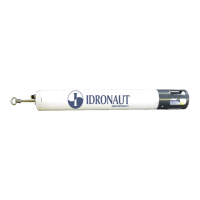
➢ The CTD is equipped with a rotary magnetic power ON/OFF switch, installed on the top
cover. The CTD is ON when the switching arm is positioned over the red dot marker. Once
the CTD self-recording configuration is completed, the CTD can be switched OFF and then
ON again at the sampling site, when ready for the deployment. This procedure is
indispensable to run self-recording data acquisitions, as described in the dedicated section
of this manual.
VERY IMPORTANT: Allow a 10-second interval between each ON/OFF cycle.
CONDUCTIVITY MEASUREMENT
➢ To obtain the best accuracy, the conductivity sensor and therefore the CTD sensor head, must
be immersed in clean seawater or freshwater for at least 15 minutes before measurements.
➢ When the conductivity sensor is not in use, it is kept dry. Therefore, when the conductivity
sensor is placed in water, very small bubbles may remain attached to the platinum ring
electrodes (seven). If such a thing happens, the measured value of conductivity will be lower
than the true one. To remove these air bubbles, degrease the inside of the conductivity cell
using cotton buds wetted with the Conductivity Sensor Cleaning Solution or with liquid soap.
Gently rotate the cotton bud against the whole internal surface of the quartz cell. This will
wet the platinum electrodes, thus reducing the surface tension of the cell and considerably
decreasing the risk of trapped air bubbles.
OXYGEN MEASUREMENT
Most polarographic oxygen sensors take 5 to 10 minutes after they have been switched on
to polarize and become stable. To overcome this limitation, the IDRONAUT OS310 has been
fitted with a small internal rechargeable device, to maintain polarization of the oxygen
sensor continuously for about three days. However, if the probe is not used for several days,
the polarization device may become completely discharged. It is recommended that the
probe should be switched ON (and streaming real-time data) for at least few minutes, to


 To Next Page