
 Need help?
Do you have a question about the Iiyama ProLite TE8604MIS and is the answer not in the manual?
Contact local support center for fault reporting and find information on www.iiyama.com/service.
Key checks to perform before contacting support to resolve common monitor issues.
Required information to prepare before reporting a screen defect to the service center.
Declares compliance with EC/EU directives for EMC, Low Voltage, ErP, and RoHS.
Recommends recycling of used products and provides a web address for information.
Essential warnings and precautions for safe operation and handling of the monitor.
Covers warnings related to electricity, cables, placement, and objects.
Cautions for installation location, ventilation, moving, and environmental conditions.
Advice on monitor usage for comfort and reducing eye strain.
Describes symptoms that are normal for LCDs and do not indicate a problem.
Notes limitations on outdoor use, screen orientation, and cable length.
Confirms product design for 24-hour usage and landscape applications.
Explains image persistence and provides methods to prevent it.
Offers tips to prevent image sticking and prolong display life in public settings.
Instructions on contacting dealer or service center for issues or packaging advice.
Guidelines for cleaning the monitor cabinet and LCD screen safely.
Lists key features like resolution, contrast, connectivity, and speakers.
Advises checking all included accessories against the list to ensure none are missing or damaged.
Recommends at least two people for safe unpacking to prevent drops and injury.
Warns against using sharp objects on the touch panel and recommends stylus or finger use.
Follow mount instructions, use qualified personnel, ensure wall strength, and handle with care.
Details on mounting stage thickness and screw usage to avoid damage or electric shock.
Advises on avoiding incident light that may affect touch screen performance.
Confirms the monitor is designed for landscape mode only.
Details the power button, power indicator states, remote sensor, light sensor, and USB connector.
Lists and describes various input/output ports like HDMI, USB, VGA, LAN, Serial, Audio.
Explains the functions of each button on the remote control for monitor operation.
Step-by-step guide for inserting AAA batteries into the remote control.
Instructions for turning the monitor ON and OFF using the power button or remote.
Steps to display the On Screen Display (OSD) menu using the remote control.
Explains how to move the cursor vertically and horizontally within menus using the remote control.
How to adjust sound volume and switch between different input sources.
Step-by-step guide for connecting the monitor to a computer and power source.
Important notes on circuit breakers, signal cables, touch function, and grounding.
Illustrates connection examples and notes about the VGA cable not being supplied.
Provides an example of connecting various peripheral devices to the monitor.
Explains HDMI out functionality and conditions for connecting multiple monitors.
Advises setting signal timing as listed on page 57.
Explains Plug & Play compliance and driver information for Windows OS.
Details multi-touch functionality and supported operating systems.
Steps to begin operating the monitor, including accessing the source menu.
Guide to navigating and using the OSD menu for adjustments.
Describes functions like Freeze, Backlight, Input, Volume, Mute, and Kiosk Mode.
Explains how to lock/unlock the Power Button and Touch function using the remote.
Details common settings and how to select different input sources.
Explains how to adjust the monitor's volume and backlight settings.
Provides options for adjusting Volume, Bass, Treble, Balance, Sound Mode, and Mute.
Options for Aspect Ratio, Pixel Shift, Eye Care, Auto Light, ECO, and ECR.
Controls for Brightness, Contrast, Hue, Sharpness, Display Mode, and Color Temperature.
Guides for manually adjusting H/V Position, Clock, Phase, and using Auto Adjust.
How to access and configure application settings via the navigation toolbar.
Explains the icons and indicators found in the status bar.
Configuration options for WiFi, Ethernet, Hotspot, Bluetooth, VPN, Wallpaper, Sound, Input, Date/Time, Language, etc.
Details for managing system storage, security settings, and firmware updates.
How to display and customize the navigation toolbar with apps and tools.
Explains saving notes and annotations to cloud drives like Google Drive/One Drive.
Descriptions of ScreenShare Pro, AirClass, Timer, StopWatch, Spotlight, Freeze, and Screen Lock functions.
How to create shortcuts and use the Multi-Windows feature.
Detailed instructions on how teachers and students use the AirClass feature.
Details on using the Note software for writing, importing, exporting, and cloud saving.
Describes extended pen functions and image expansion capabilities.
How to browse and manage files, including supported formats and tools.
How to save to cloud drives and access remote files via SAMBA/FTP.
Instructions for using the web browser and connecting to cloud drives.
Details on EShare Pro for multiscreen interaction and Keeper for system cleanup.
Descriptions of illustration, PC switching, visualizer, and office suite applications.
Explains the purpose of adjustments and preferred resolution for best performance.
Steps to display optimum resolution and use the test pattern wallpaper.
Guides for executing Auto Adjust and manual adjustments for image position and clock.
How to adjust Phase, Brightness, and Color for optimal picture quality.
Explains the standby feature for power saving and its compliance with ENERGY STAR/VESA DPMS.
Details how the monitor enters standby mode and how to wake it up.
Checks for issues like no picture, screen not synchronized, or incorrect position.
Troubleshooting steps for brightness, dark screen, shaking, no sound, or strange noises.
Troubleshooting steps for touch screen response and position deviation.
Information on how to recycle the monitor for environmental protection.
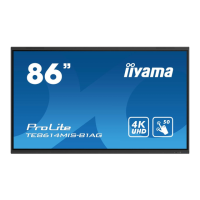
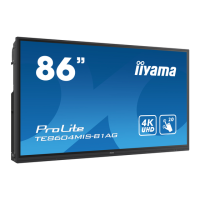
Detailed technical specifications for the ProLite TE8604MIS model.
Detailed technical specifications for the ProLite TE7504MIS model.
Detailed technical specifications for the ProLite TE6504MIS model.
Lists compliant video timings for various resolutions and input signals.
Visual representation and measurements for the ProLite TE8604MIS model.
Visual representation and measurements for the ProLite TE7504MIS model.
Visual representation and measurements for the ProLite TE6504MIS model.
 General
| Pixel pitch | 0.4935 x 0.4935 mm |
|---|---|
| Response time | 8 ms |
| Display diagonal | 86 \ |
| Touch technology | Multi-touch |
| Display brightness | 350 cd/m² |
| Display technology | IPS |
| Native aspect ratio | 16:9 |
| Horizontal scan range | 30 - 80 kHz |
| Touchscreen technology | Infrared |
| Contrast ratio (dynamic) | 3500:1 |
| Contrast ratio (typical) | 1200:1 |
| Display number of colors | 1.07 billion colors |
| Display diagonal (metric) | 217.4 cm |
| Active display area (W x H) | 1895 x 1066 mm |
| Number of simultaneous touchpoints | 20 |
| Orientation | Horizontal |
| Product color | Black |
| Product design | Digital signage flat panel |
| Bezel width (side) | 14 mm |
| Placement supported | Indoor |
| Bezel width (bottom) | 43 mm |
| Panel mounting interface | 800 x 600 mm |
| AC input voltage | 100 - 240 V |
| AC input frequency | 50 - 60 Hz |
| Power consumption (standby) | 0.5 W |
| Power consumption (typical) | 390 W |
| Package depth | 270 mm |
| Package width | 2102 mm |
| Package height | 1278 mm |
| Package weight | 84300 g |
| Purpose | Universal |
| Number of OSD languages | 9 |
| Operating hours (hours/days) | 24/7 |
| Mean time between failures (MTBF) | 50000 h |
| On Screen Display (OSD) languages | CZE, DEU, DUT, ENG, ESP, FRE, ITA, POL, RUS |
| Graphics card | Mali-G52 |
| Internal memory | 4 GB |
| Processor cores | 4 |
| Processor family | ARM Cortex |
| Processor architecture | ARM Cortex-A73 |
| Internal storage capacity | 32 GB |
| Operating system installed | Android |
| DVI port | - |
| Interface | USB |
| USB version | 3.2 Gen 1 (3.1 Gen 1) |
| USB ports quantity | 5 |
| Ethernet LAN data rates | 1000 Mbit/s |
| HDMI input ports quantity | 3 |
| Ethernet LAN (RJ-45) ports | 2 |
| HDMI output ports quantity | 1 |
| Cables included | AC, HDMI, USB, USB Type-C |
| RMS rated power | 32 W |
| Storage temperature (T-T) | -20 - 60 °C |
| Operating temperature (T-T) | 0 - 40 °C |
 Weight and Dimensions
| Depth | 86 mm |
|---|---|
| Width | 1957 mm |
| Height | 1159 mm |
| Weight | 64400 g |




 To Next Page