ENGLISH
28
2. The rst section of the line connected to the pump outlet
must be a exible hose, in order to isolate vibration
produced by the pump from the rest of the system.
3. Use high pressure pipes and ttings to ensure high safety
margins in all operating conditions.
4. The outlet line must always be provided with a Max.
pressure valve.
5. Use pressure gauges capable of withstanding the
pulsating loads typical of plunger pumps.
6. During the design stage, keep in mind the line pressure
drops that lead to a pressure reduction at the user with
respect to the pressure measured on the pump.
7. For those applications where pulses produced by the
pump on the outlet line may prove harmful or unwanted,
install a pulsation dampener of sucient size.
9.9 Calculation of the internal diameter of the
duct pipes
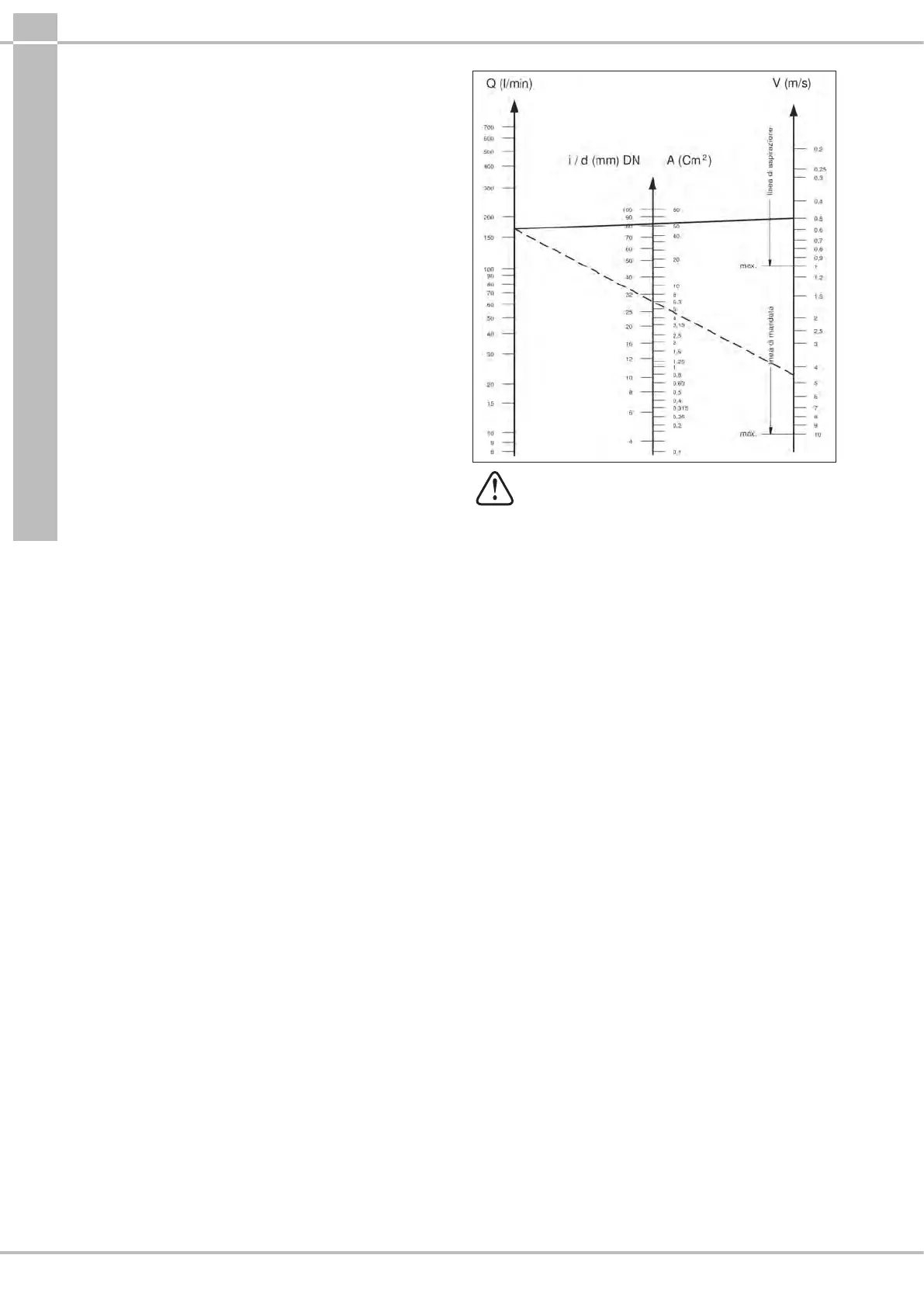
To determine the internal diameter of the duct, refer to the
following diagram:
Suction duct
With a ow rate of ~ 170 l/min and a water velocity of 0.5 m/
sec. The graph line joining the two scales meets the central
scale showing the diameters, corresponding to a value of ~ 80
mm.
Outlet duct
With a ow rate of ~ 170 l/min and a water velocity of 5.5 m/
sec. The graph line joining the two scales meets the central
scale showing the diameters, corresponding to a value of ~ 30
mm.
Optimal speeds:
- Suction: ≤ 0.5 m/sec.
- Outlet: ≤ 5.5 m/sec.
The graph does not take into account pipe
resistance, valves, load loss produced by the length
of the ducts, the viscosity of the liquid pumped or
the temperature itself.
If necessary, contact our Technical or Customer
Service Departments.


 To Next Page