ENGLISH
26
Replace the oil lling hole closing service plug
(red) positioned on the rear casing cover. Check
the correct quantity with the oil dipstick.
The dipstick must always be accessible, also when
the unit is installed.
Grounding: It is necessary to x a grounding
cable to the pump by means of the M6 stainless
steel screw and the stainless steel toothed washer
properly marked by the YELLOW label. See “ATEX
EXPLOSION PROTECTION” manual.
The pump shaft (PTO) must not be rigidly
connected to the drive unit.
The following types of transmission are
recommended:
- Hydraulics by ange, for proper application
consult with our Technical or Customer Service
Departments.
- V-belts.
- Cardan-shaft (comply with manufacturer's Max.
recommended working angles).
- Flexible joint.
In all cases the transmission must be assembled
correctly to avoid incorrect or harsh operation of
the connection parts and to prevent excessive
wear, temperature rise and/or hazardous breakages
that may create potential sources of ignition and
explosion. See “ATEX EXPLOSION PROTECTION”
manual.
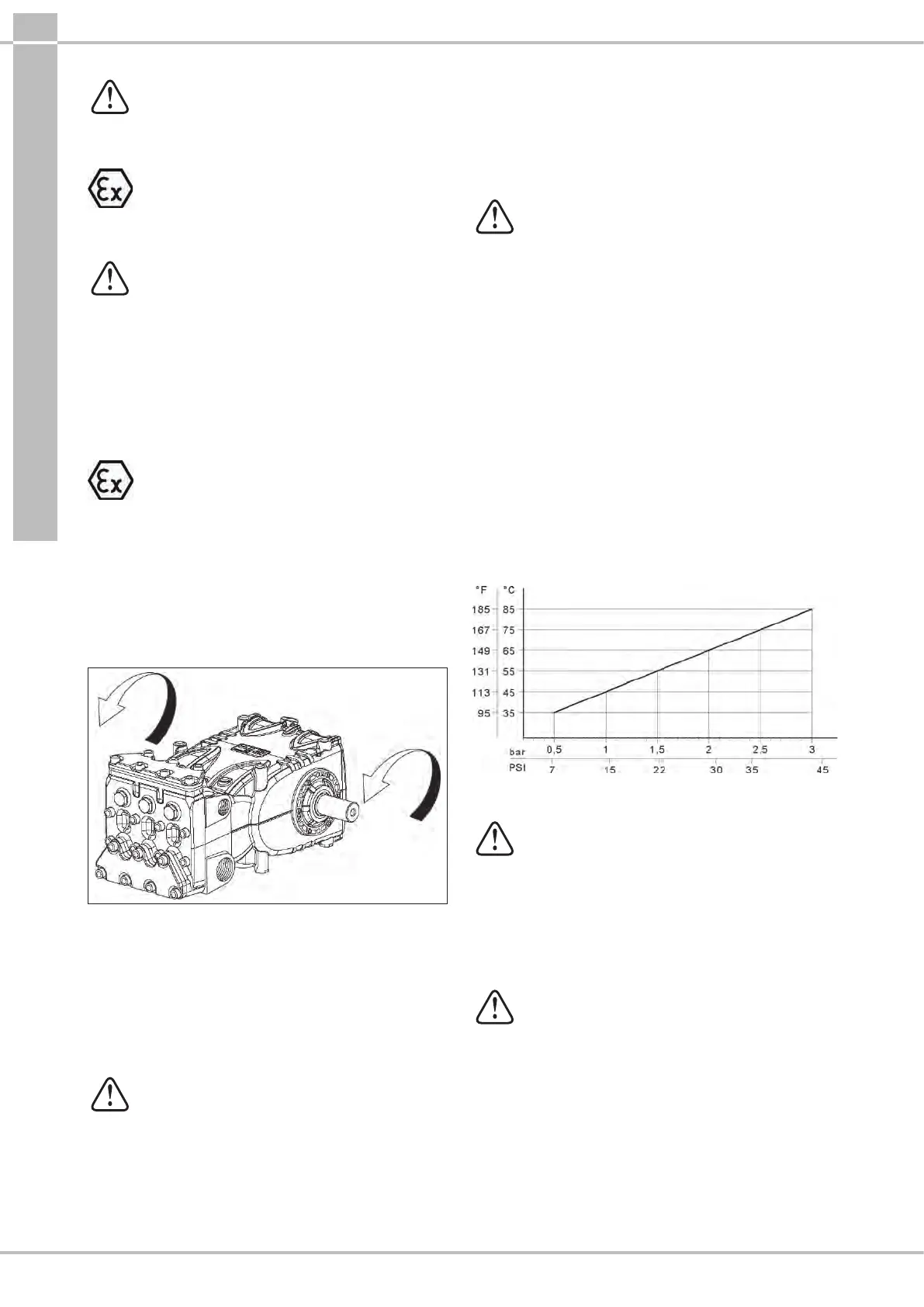
9.2 Rotation direction
The rotation direction is indicated by an arrow located on the
casing near the drive shaft.
From a position facing the pump head, the rotation direction
will be as in Fig.5.
LH SIDE
clockwise
RH SIDE
anticlockwise
Fig.5
9.3 Version change
The pump version is dened as right when:
Observing the pump facing the head side, the pump shaft
must have a PTO shank on the right side.
The pump version is dened as left when:
Observing the pump facing the head side, the pump shaft
must have a PTO shank on the left side.
Note. The version shown in Fig.5 is right.
The version can only be modied by trained and
authorized personnel and carefully following the
instructions below:
1. Separate the hydraulic part from the mechanical
part as indicated in chapter2 par.2.2.3 of the
Repair manual.
2. Turn the mechanical part 180° and reposition
the rear casing cover in such a way that the
oil dipstick is turned upward. Reposition the
lifting bracket and relative hole closing plugs
in the upper part of the casing. Finally, properly
reposition the specication label in its housing
on the casing.
Make sure that the lower casing draining
holes in correspondence with the pistons are
open and not closed from the plastic plugs
provided for the previous version.
3. Unite the hydraulic part to the mechanical part
as indicated in chapter2 par.2.2.5 of the Repair
manual.
9.4 Hydraulic connections
In order to isolate the system from vibrations produced by
the pump, it is advisable to make the rst section of the duct
adjacent to the pump (both suction and outlet) with exible
piping. The suction hose must be suciently rigid to prevent
deformation due to the negative pressure exerted by the
action of the pump.
9.5 Pump supply
A positive head of at least 0.20 metres is required for the best
volumetric eciency with the uid at ambient temperature
(see par.9.6).
While with the uid at high temperature max. 85°C, observe
the diagram below Fig.6 that denes the minimum supply
pressures according to the dierent temperatures.
Water temperature
Head
Fig.6
For negative prevalence contact our Technical or
Customer Service Departments.
9.6 Suction line
For smooth operation of the pump, the suction line must have
the following characteristics:
1. Minimum internal diameter as indicated in the graph in
par.9.9 and in any case equal to or exceeding that of the
pump head.
Localized restrictions should be avoided along the
piping, as these can cause pressure drops resulting
in cavitation. Avoid 90° elbows, connections with
other piping, restrictions, reverse gradients, inverted
U-curves and Tee connections.
2. The layout must be made so as to ensure a minimum
positive head under all operating conditions of 0.20 m
(0.02 bar) and a maximum one of 80 m (8 bar) measured
on the pump supply; this minimum value applies for
cold water with temperature up to 20°C, for higher
temperatures refer to the specic graph (par.9.5).
The pumps can also operate with a lower supply pressure,
under certain operating conditions expressly authorized
by our Technical or Customer Service Departments.


 To Next Page