The Dostec AC is a diaphragm or piston dosing pump designed for accurate and efficient automatic dosing across various industries, including water treatment, chemical, food, and agriculture. It offers a wide flow range from 3 to 1200 l/h at pressures up to 20 bar, with head materials available in PP, PVDF, and stainless steel to suit different chemical applications.
Function Description:
The pump's operation is driven by a motor that transmits rotational motion through a reducer, consisting of a pinion and a ring gear. These components are linked to a shaft with an eccentric bearing, which in turn pushes a shaft connected to either a diaphragm or a piston. The return movement is facilitated by a spring. A high-resolution encoder continuously monitors the instantaneous position and speed, allowing the Advanced Control Unit (ACU) to perform closed-loop adjustments for torque and rotation speed. By varying the motor speed, the pump can adjust its flow rate from 10% to 100% of its rated capacity, depending on the selected operating mode.
Operating Modes:
The Dostec AC offers several operating modes to cater to diverse dosing requirements:
- Manual Mode: Allows for manual adjustment of the dosing flow rate via the keyboard.
- Analogue Mode: Dosing is proportional to an external 0/4-20 mA analogue signal.
- Proportional to Flow Rate: Dosing is proportional to a water flow rate, typically managed via a flowmeter.
- Proportional by Pulses: The stroke frequency is proportional to input pulses, configurable as X:Y pulses for low-frequency inputs (0.005-30 Hz) or %/ppm for high-frequency flow meters (1-300 Hz).
- Batch Control by Volume: Doses a specified volume, with activation options including manual, remote, or timed.
- Batch Control by Time: Doses for a specified duration, with activation options including manual, remote, or timed.
- ModBus: Dosing control is managed through the ModBus RTU protocol via an RS-485 serial port.
Key Components:
The pump assembly includes a motor, an Advanced Control Unit (ACU), an encoder, a cylinder, suction and injection valves, and a block. Optional additional ventilation can be integrated for continuous operation in higher temperature environments.
Technical Specifications:
- Voltage: AC3: 230 V ± 10%; AC2: 110 V ± 10%.
- Power: 0.43 kW (0.58 HP) or 1.2 kW (1.6 HP).
- Protection: IP-55.
- Materials:
- Piston: P.E.U.A.P.M. / Ceramic / AISI316.
- Diaphragm: P.T.F.E. Fibre-reinforced elastomer base.
- Retention: FPM.
- Cylinder: P.P. / PVDF / AISI316.
- Valve (body): P.P. / PVDF / AISI316.
- Valve (ball): Soda lime / Borosilicate / AISI316.
- Ambient Temperature: 0 to 45 °C.
- Media Temperature: PP: 0 to 50 °C; PVDF: -10 to 50 °C; ST. STEEL: -10 to 60 °C.
- Relative Humidity Max.: 95% without condensation.
- Noise Level dB(A): Less than 70.
- Weight: AC3: 24 kg (53 lb); AC2/1: 13 kg (29 lb).
- Analogue Input: 0/4-20 mA.
- External Pulse Input: For flowmeter integration.
- Remote Activation Input: On/off control.
- Level Sensor Input: For pre-warning and alarm.
- Leakage Detector Input: For diaphragm leakage.
- Flow Detector Input: For monitoring flow.
- Pressure Sensor Input: For pressure monitoring.
- RS-485 ModBus Serial Port: For communication and control.
- 4-20 mA Log and Monitoring Output: For data logging.
- Log Output, Monitoring, and Control of Second Pulse Pump: For advanced control.
- Alarm Output (Relay): For general alarms.
- Level Alarm Output (Relay): For level-specific alarms.
Usage Features:
- Pump Calibration: Allows for calibration in real working conditions via a product suction test of a given duration (at least 60 seconds recommended). The pump runs at maximum flow during the test, and the user enters the suction volume to recalculate the dosing flow.
- Dosing Modes (Advanced Functions):
- Standard (ST): Normal operating mode with symmetrical suction and discharge.
- Low Flow (LF): Pauses dosing during discharge, reducing flow to as little as 1% for precise dosing.
- Slow Suction (SS): Reduces suction speed for viscous liquids to prevent cavitation and improve head filling, reducing maximum flow by 50%.
- Low Pulsation (LP): Lengthens impulse cycle time to minimize pulsating flow and reduce overpressures, with maximum flow reduced based on reducer model frequency.
- Configuration Options:
- Units: Selection of flow (litres/gallons), pressure (bar/psi), and proportionality (%/ppm) units.
- Flowmeter: Configuration for low (0.005-30 Hz) or high (1-300 Hz) frequency flowmeters, including constant (volume/pulse or pulses/volume) entry.
- Lock Code: Secures access to equipment configuration, allowing only start/stop functions.
- ModBus: Enables control via RS485 serial port.
- Remote Activation: External dry contact can start and stop the pump.
- Priming Function Test: Allows the pump to run at maximum speed for 3 seconds for quick testing and priming.
Maintenance Features:
- Maintenance Menu: Displays the status of wear components (oil, valves, diaphragm, bellows) using status bars. A warning appears when a component reaches the end of its useful life, indicated by an empty bar and a "!" symbol, prompting replacement.
- Cycle Counter Reset: After replacing a component, the cycle counter can be reset to zero.
- Periodic Maintenance Schedule:
- Oil Change: First change after 500 hours, then every 2000 hours (minimum once a year).
- Piston, Seals, Diaphragm, Bellows Check: Every 3 months or 1000 hours.
- Suction Filter Check: Once a month.
- Valves Check: Every 3 months or 1000 hours.
- Cleaning Recommendation: Periodically circulate clean water through the pump to remove precipitated remains from the cylinder and pipes.
- Corrosive Liquids: For highly corrosive liquids, it is recommended to double the frequency of checks.
Safety Instructions:
Personnel responsible for installation, commissioning, and maintenance must follow the instructions in the manual, paying special attention to detailed recommendations and warnings, to prevent personal injury, environmental damage, and ensure proper equipment operation. Specific instructions for the chemicals being dosed must also be adhered to. Electrical protection for the motor, an emergency disconnection device, and protection against false starts are mandatory.

 Need help?
 General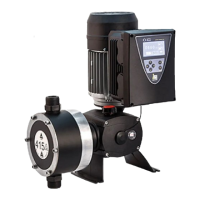

 To Next Page