48
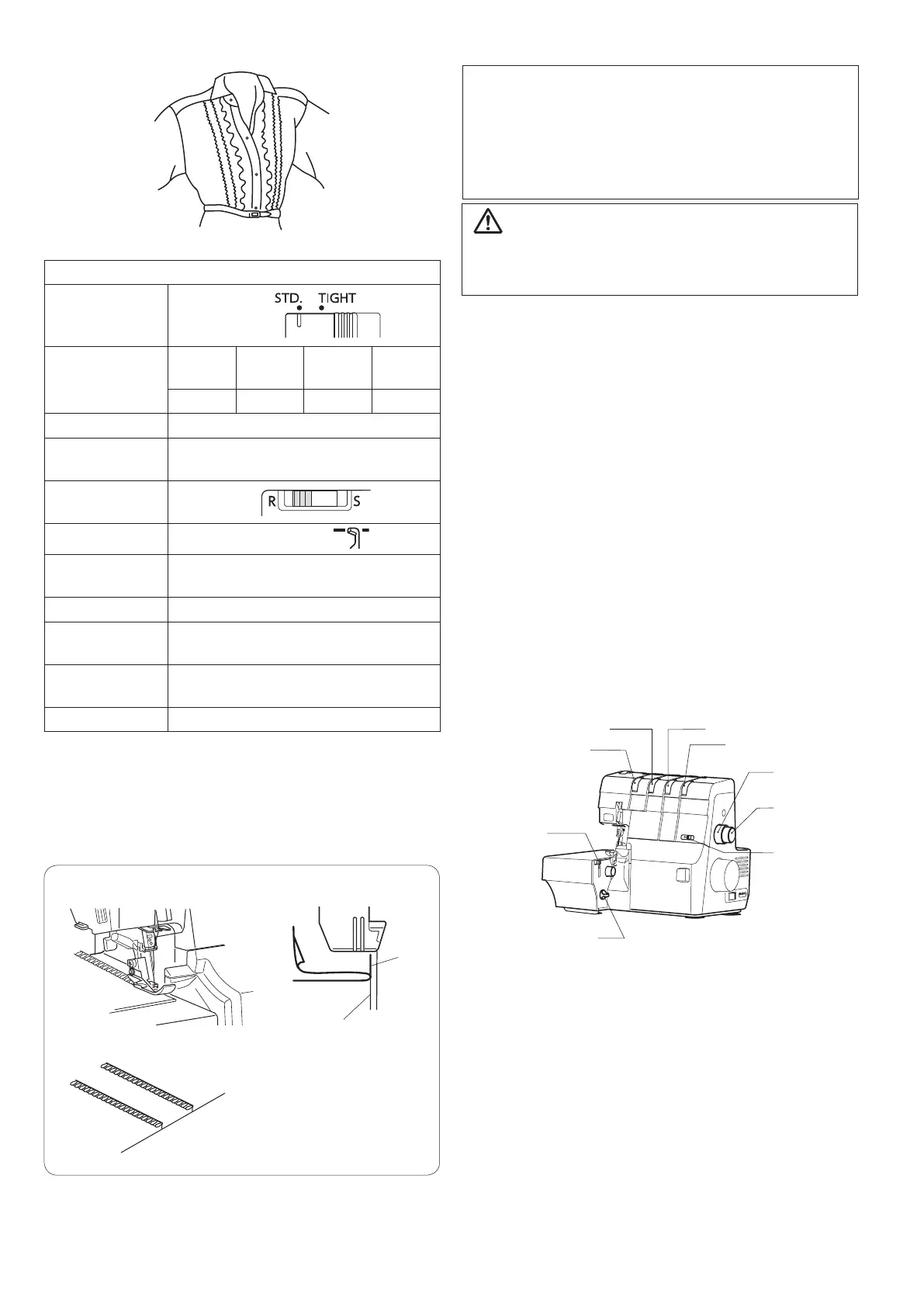
Pintucking
Sewing
z Sew the folded edge while guiding it along the guide
line.
q Right side of fabric
w Folded edge
e Guide line on the needle plate
x Open the fold at and press the pintucks to one side.
* After you nish sewing, return the upper knife to the
original position (activated).
q Left needle thread tension dial
w Right needle thread tension dial
e Upper looper thread tension dial
r Lower looper thread tension dial
t Chaining nger switch knob
y Upper knife release knob
u Stitch length dial
i Differential feed dial
o Lower looper pre-tension setting slider
* Refer to page 10 for details on how to remove the
needle.
* Refer to page 11 for details on how to adjust the
stitch length.
* Refer to page 11 for details on how to adjust the
difference ratio.
* Refer to page 12 for details on how to deactivate/
activate the upper knife.
* Refer to page 13 for details on how to adjust the
chaining nger switch knob.
CAUTION
Make sure to turn the power switch off before
changing the needle, deactivating/activating the upper
knife or setting the chaining nger switch knob.
w
q
e
r
t
y
u
i
o
q
w
e
z
x
Machine Setting
Lower looper
pre-tension
setting slider
STD.
Standard setting
of tension dials
Left
needle
Right
needle
Upper
looper
Lower
looper
- 4 5-7 2-4
Stitch length dial R
Differential feed
dial
1.0
Chaining nger
switch knob
R
Upper knife Deactivated
Needle
Use the right needle:
HA-1 SP No. 14 or No. 11
Needle thread Synthetic: No. 80 - 100
Upper looper
thread
Synthetic: No. 80 - 100
Lower looper
thread
Synthetic: No. 80 - 100
Fabric Light weight, knit fabric
NOTE:
• You may need to adjust the thread tension
depending on the type of fabric and thread being
used.
• If the tension balance on the test piece is not
satisfactory, you can adjust the thread tension with
the thread tension dial.





 To Next Page