(24) Inspect for pinched or leaking fuel tubes.
Inspect for pinched, cracked or leaking fuel hoses.
(25) Inspect for exhaust system restrictions such
as pinched exhaust pipes, collapsed muffler or
plugged catalytic convertor.
(26) If equipped with automatic transmission, ver-
ify electrical harness is firmly connected to park/neu-
tral switch. Refer to Automatic Transmission section
of Group 21.
(27) Verify that electrical harness connector is
firmly connected to the vehicle speed sensor (Fig. 15).
(28) 2.5L 4–Cylinder Engine Only: Verify good
electrical connection at power steering pressure
switch (Fig. 16). This switch is not used with 4.0L
engines.
(29) Verify good electrical connections at fuel pump
module connector at front of fuel tank (Fig. 17).
(30) Verify good EVAP canister vent line connec-
tion at front of fuel tank (Fig. 17).
(31) Verify good fuel supply line connection at
front of fuel tank (Fig. 17).
(32) Inspect all fuel lines/hoses for cracks or leaks.
(33) Inspect transmission torque convertor housing
(automatic transmission) or clutch housing (manual
transmission) for damage to timing ring on drive
plate/flywheel.
(34) Verify battery cable and solenoid feed wire
connections to starter solenoid are tight and clean.
Inspect for chaffed wires or wires rubbing up against
other components.
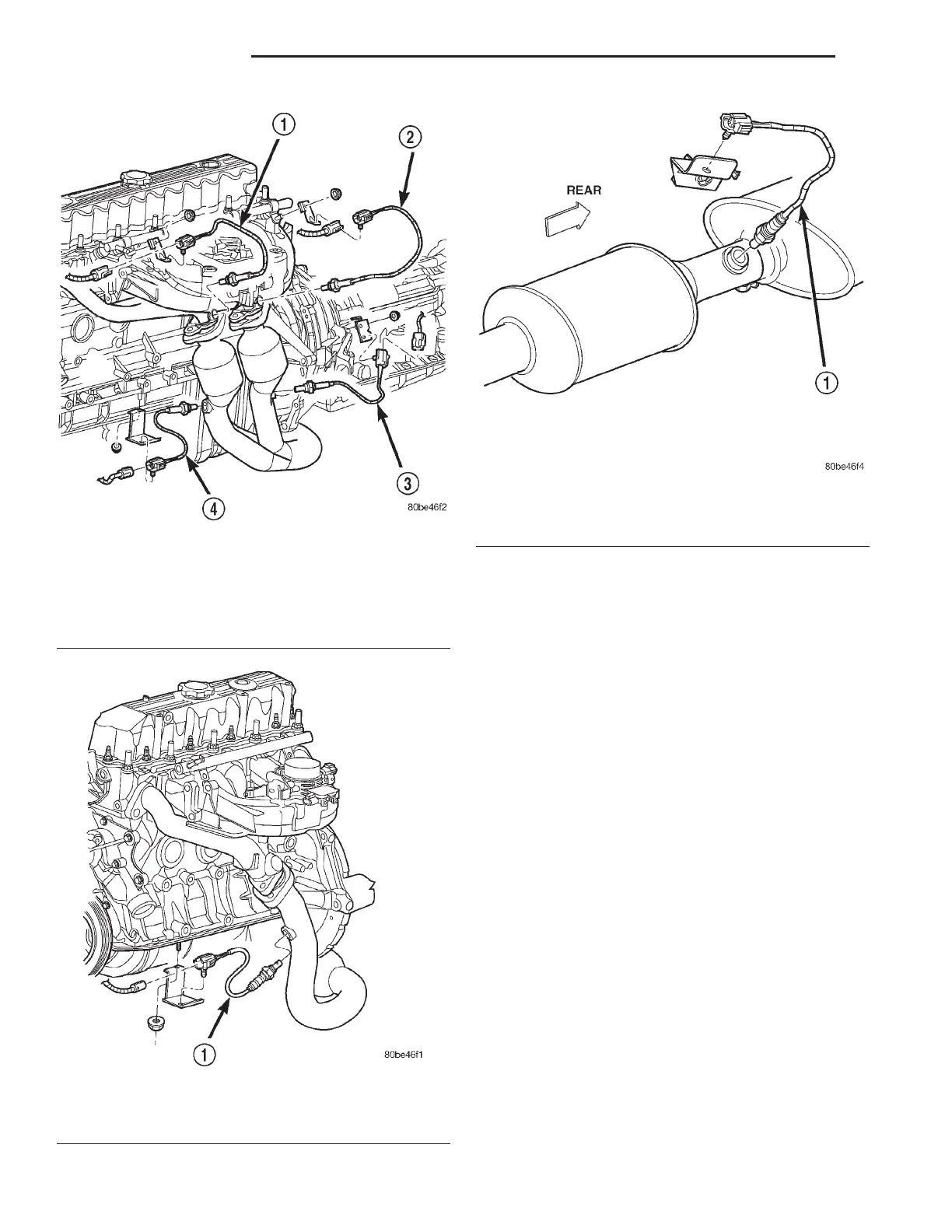
Fig. 12 Oxygen Sensors—4.0L—California
Emissions
1 – 1/1 O2S
2 – 2/1 O2S
3 – 2/2 O2S
4 – 1/2 O2S
Fig. 13 Front Oxygen Sensor—2.5L—Federal
Emissions
1 – 1/1 O2S
Fig. 14 Rear Oxygen Sensor—2.5L/4.0L—Federal
Emissions
1 – 1/2 O2S
14 - 40 FUEL SYSTEM XJ
DIAGNOSIS AND TESTING (Continued)









 To Next Page