Page 22
D. If an ALU function was selected ensure the wheel weights have been placed in accordance to the program
chosen.
E. Check that the wheel is not slipping against the backing collar.
F. Check that the wheel and adaptors are clean.
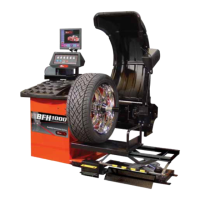
Graphic 1.
6.8 VIBRATION PROBLEMS
If vibration is still present after balancing, check the following possible sources of vibration:
1. Stones caught in the tire tread.
2. Tire slippage on the wheel.
3. Incorrectly mounted wheel.
4. Imbalanced wheel covers.
5. Excessive radial or lateral runout in the tire or wheel.
6. Damaged wheel bolt holes.
7. Worn universal joints.
8. Imbalanced brake rotors or drums.
9. Worn or damaged balancer accessories.
7.0 SPOKE BALANCING MODE
A standard dynamic balance in ALU mode places compensation weight in two planes, inner and outer, at the
bottom dead center for each plane of calculated imbalance. Sometimes the outside weight placement may be
unsightly on a custom wheel. The Spoke Mode is designed to “hide” outer plane corrective weight by placing the
required weight behind selected spokes in order to retain the esthetic appeal of the wheel.
1. Press the Spoke button, F5.
2. Outer weights will be divided. Weights may not be equal depending on the spoke positions relative to the
imbalance position.
3. Place stick-on weights where indicated by the laser pointer.
4. Perform a check spin if desired.
NOTE: Stick-on weight position can be “tweaked” by depressing the lower part of “F1” while rotating the shaft fore
or aft until the laser locates in the desired position. Inner or Outer placement indicator must be “in the green”
before depressing the button.


 To Next Page