F4-CV Series VAV Terminal Equipment
Controllers Installation Guide
Application
The CV series controllers are designed for variable air
volume (VAV) box applications.
These controllers operate on an RS-485 BACnet
®
MS/
TP bus as BACnet Advanced Application Controllers (B-
AACs) and integrate into Johnson Controls
®
and third-
party BACnet systems. CV series controllers feature 14
preloaded standard applications to allow this controller
to operate standard VAV box equipment with a proven
energy-efficient sequence of operation, without the need
for programming. For information on configuring a CV
series controller to use a preloaded application, see
Setting a preloaded application. These controllers are also
fully programmable, using the Controller Configuration
Tool (CCT), providing the flexibility to create custom
control sequences.
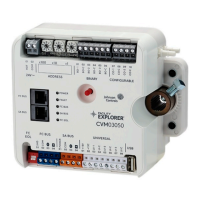
CVM03050 controllers feature an integral damper
actuator, a digital Differential Pressure Transmitter (DPT)
sensor, and a 32-bit microprocessor. The CVM03050-0P
model features an integral potentiometer to sense actual
VAV box damper position.
CVM03050 controllers also include an integral real-
time clock, which enables the controllers to monitor
and control schedules, calendars, and trends, and
operate for extended periods of time as stand-alone
controllers when offline from the Facility Explorer
®
system
network. These controllers connect easily to the wired
and wireless network sensors for zone and discharge air
temperature sensing. Their small package size facilitates
quick field installation and efficient use of space without
compromising control performance.
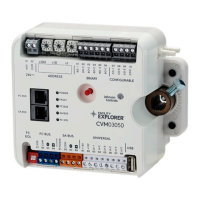
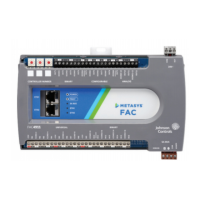
Figure 1: F4-CVM3050
Communications protocols
The CVM03050 controllers can communicate using
BACnet MS/TP, N2, or wireless Zigbee
®
. By default, the
CVM controllers communicate using the BACnet MS/TP
protocol. The BACnet protocol is a standard for ANSI,
ASHRAE, and the International Standards Organization
(ISO) for building controls.
The CVM controllers can be used as functional
replacements for legacy N2 controllers. The N2-capable
MS/TP equipment controller models provide a cost-
effective upgrade and modernization path for customers
with existing N2 controllers. For installation and
commissioning support, and tips for efficient and safe
replacement, refer to the Modernization Guide for Legacy
N2 Controllers (LIT-12012005) and the controller-specific
documentation. For information about mapping N2
Objects in controllers with switchable communications
protocols, refer to the N2 Compatibility Options chapter of
the Controller Tool Help (LIT-12011147).
To configure CVM controllers to communicate using
the N2 communications protocol, see Configuring N2
communications.
The CVM controller can also be installed in a wireless
application using an FX- ZFR/ZFR Pro Wireless Field Bus
Router. To configure these controllers to communicate
using the wireless communications protocol, see
Configuring wireless communications.
North American Emissions Compliance
United States
This equipment has been tested and found to comply
with the limits for a Class A digital device pursuant to
Part 15 of the FCC Rules. These limits are designed
to provide reasonable protection against harmful
interference when this equipment is operated in a
commercial environment. This equipment generates,
uses, and can radiate radio frequency energy and, if not
installed and used in accordance with the instruction
manual, may cause harmful interference to radio
communications. Operation of this equipment in a
residential area may cause harmful interference, in which
case the users will be required to correct the interference
at their own expense.
Canada
This Class (A) digital apparatus meets all the
requirements of the Canadian Interference-Causing
Equipment Regulations.
Cet appareil numérique de la Classe (A) respecte toutes
les exigences du Règlement sur le matériel brouilleur du
Canada.
*241014301809C*
Part No. 24-10143-01809 Rev. C
2020-11-11
(barcode for factory use only)
F4-CVM03050-0, F4-CVM03050-0P




 To Next Page
