40
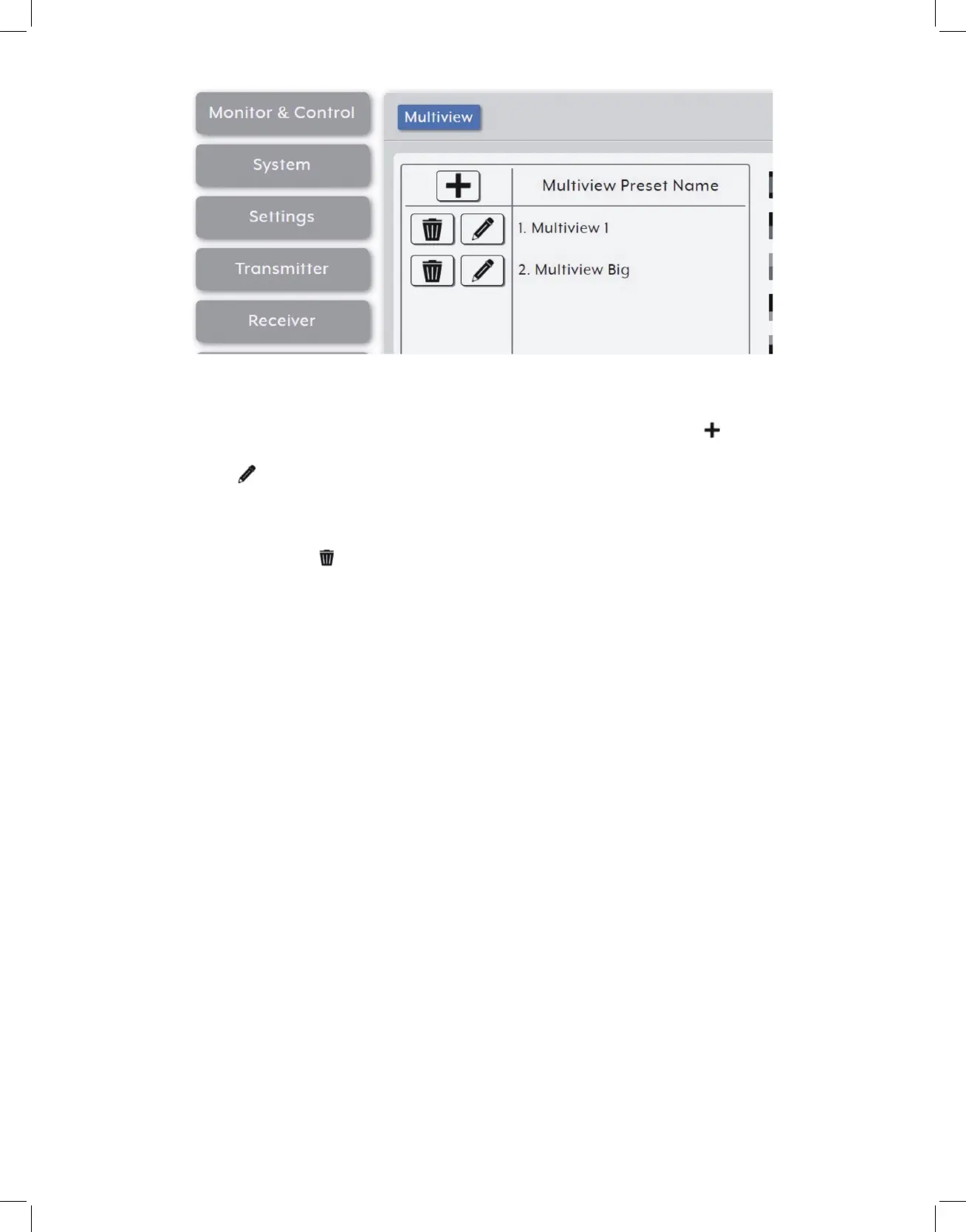
1. Multiview Preset List: The upper left section of this tab contains a list of all currently
defined multiview presets in the system and provides a way to create new presets, edit
them, or delete them. To add a new preset, click on the “Add” icon ( ) and then select
the preferred options and window configuration. To edit an existing preset, click on the
“Edit” icon ( ) and then make whatever changes are required. Once a new or edited
multiview preset has been configured, click on the “Save Preset” button at the bottom
of the page to store the preset’s configuration. To save and immediately activate the
current multiview preset, click on the “Execute” button. To delete an existing preset, click
on the “Delete” icon ( ) next to the appropriate preset’s name.
Note: Deleting a multiview preset will not disable the multiview output it described if it is currently
active. To completely remove a multiview output, a new source needs to be routed to the display,
or the output needs to be disabled from the Monitor & Control Tab.
• Order: Use the dropdown to reorder the video wall groups in the list. Changing the
order here will also change the order the groups are listed in other tabs.
• Preset Name: Set the name of the multiview preset here.
• Receiver: Select the receiver to display the multiview output when the “Execute”
button is used.
• Display Resolution: Select the output resolution for the multiview receiver.
• Aspect Ratio: Select the aspect ratio logic to use when displaying sources within
their multiview windows. Selecting “Best Fit” will maintain the aspect ratio of the
original source while filling the window as much as possible and adding black bars
where necessary. Selecting “Full Screen” will stretch a source to fit the window,
regardless of the original source’s aspect ratio.
Note: This setting applies to all sources/windows within the current multiview preset.


 To Next Page