
 Need help?
Do you have a question about the KEB ACOMBIVERT F5 X3A and is the answer not in the manual?
This document provides comprehensive instructions for the COMBIVERT F5 Encoder Interface, specifically designed for Channel 1 SIN/COS and Channel 2 variable applications. It covers installation, connection, and start-up procedures, along with detailed parameter adjustments for optimal performance with inverters and servos.
The COMBIVERT F5 Encoder Interface is an essential component for integrating encoders into drive systems, enabling precise position and speed control. Each interface card includes two channels, offering flexibility for various applications. Channel 1 is dedicated to SIN/COS encoder signals, providing high-resolution feedback for accurate motion control. Channel 2 is designed for variable encoder types, allowing for adaptability to different encoder technologies.
The core function of the interface is to convert analog or digital encoder signals into a format usable by the COMBIVERT inverter/servo. For SIN/COS encoders, it processes the sinusoidal signals (A, B, C, D tracks) and the zero track (R) to determine absolute and incremental positions. The absolute tracks (C and D) provide an initial, relatively inaccurate absolute value upon start-up, which is then corrected by the first zero pulse. This eliminates the need for an approach to a reference point. The incremental tracks (A and B) are used for continuous counter and direction detection, offering high-resolution feedback.
A critical aspect of the interface's function is its encoder monitoring system. This software-based feature continuously checks the integrity of both absolute and incremental encoder tracks. It monitors signal levels and triggers an error if they fall below permissible thresholds, ensuring reliable operation and preventing potential system malfunctions. The monitoring system's response time varies depending on the encoder type, typically ranging from 16 ms for incremental tracks to 30 ms for absolute tracks, with a potential response time of 100 ms or more for certain encoder types.
The interface also manages the power supply for the connected encoders, providing both 24 V and 5.25 V outputs. The current draw for the encoder supply is carefully regulated, with different limits for various encoder types (e.g., Hiperface, Sin/Cos, EnDat, SSI-Sin/Cos, UVW) to ensure stable operation. An external voltage supply can also be utilized for the control terminal strip, offering flexibility in power configurations.
The COMBIVERT F5 Encoder Interface is designed for straightforward integration and operation within KEB drive systems. Its usage involves several key steps, from mechanical installation to parameter configuration.
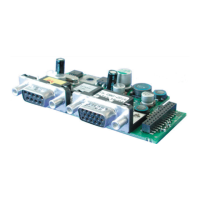
Mechanical Installation: Installation requires authorized personnel to ensure compliance with EMC and safety rules. The process involves de-energizing the inverter, awaiting capacitor discharge, removing the operator and plastic cover, and then fixing the interface board directly into the socket connector. Finally, the fixing bolt is screwed in, and the plastic cover is re-attached. This structured approach ensures safe and correct physical integration.
Encoder Connection: The interface utilizes a SUB-D15 socket for encoder connections. Specific wiring guidelines are provided to ensure proper signal integrity and shielding. Encoder cables should be double-shielded and twisted in pairs. The exterior shielding must be connected to PE/GND at both ends, while the interior shielding is connected to COM at one side only. It is crucial not to connect the exterior and interior shielding together. This meticulous wiring scheme minimizes electromagnetic interference and ensures reliable signal transmission.
Start-up and Parameter Adjustment: After mechanical installation and connection, the inverter/servo software requires specific adjustments. This includes switching on the inverter, selecting the appropriate application mode (e.g., F5-S for synchronous motors), and configuring encoder parameters. Key parameters include:
The interface provides detailed status messages via parameter Ec.37, which are crucial for troubleshooting and verifying correct operation. These messages indicate various conditions, such as successful position value transfer, encoder unknown status, incorrect incremental or absolute track signals, position deviation, and mismatches in increments per revolution. These status codes guide users in diagnosing and resolving issues during start-up and operation.
Encoder Line Length: The maximum encoder cable length is limited to 50 meters, primarily due to voltage drop in the supply line. A formula is provided to calculate the permissible line length based on the supply voltage, maximum encoder current, minimum input voltage, and the KEB encoder cable resistance. This feature helps users design their systems within safe operational limits.
The COMBIVERT F5 Encoder Interface incorporates features that contribute to its long-term reliability and ease of maintenance, primarily through its diagnostic capabilities and robust design.
Encoder Monitoring (Ec.42): The encoder monitoring function is a key maintenance feature. By continuously checking signal levels of both absolute and incremental tracks, it proactively identifies potential issues. If signal levels fall below acceptable thresholds, an "Error! Encoder 1" (value 32) is triggered. This early warning system allows operators to address problems before they lead to critical system failures. The parameter Ec.42 allows users to configure the monitoring mode, including options to turn it off, turn it on, or enable it with open-loop off, or simply issue a warning. This flexibility enables tailoring the monitoring to specific application requirements.
Status Messages (Ec.37): The comprehensive status messages provided by parameter Ec.37 are invaluable for maintenance. They offer real-time insights into the encoder and interface status. For example, a value of "16" indicates correct operation, while other values signal specific errors such as:
These detailed messages enable maintenance personnel to quickly pinpoint the root cause of an issue, reducing diagnostic time and facilitating efficient repairs. Errors like "Encoder Change" (E.EncC) are triggered when the correct evaluation of the position is no longer guaranteed, prompting immediate attention. The ability to reset errors, such as those related to wrong increments per revolution, by adjusting the correct parameter, simplifies recovery procedures.
Encoder Formatting (Value 92): In cases where an encoder with memory structures different from the KEB-definition is connected, the interface can re-organize the encoder's memory. This formatting procedure, indicated by status value 92, ensures compatibility and allows data to be written correctly. While this process can take several seconds, it is a crucial maintenance feature for integrating diverse encoder types.
Robust Design: The use of KEB encoder cables, specified for industrial environments, contributes to the overall maintainability. These cables are trailing capable, oil resistant, and designed for constant operation up to 80 °C, ensuring durability and reducing the need for frequent replacements in harsh conditions. The general design principles, including the requirement for authorized personnel for installation and adherence to EMC and safety rules, underscore a commitment to a robust and reliable system that minimizes maintenance interventions.
 General
| Category | DC Drives |
|---|---|
| Series | ACOMBIVERT F5 |
| Enclosure Rating | IP20 |
| Protection Class | Class I |
| Communication Interfaces | PROFIBUS |
| Protection Features | Overcurrent, Overvoltage, Undervoltage, Overtemperature, Short-circuit |


 To Next Page