KIRLOSKAR CHILLERS PRIVATE LIMITED
A Kirloskar Group Company IOM-KAC-ENG - Page 18
Low and high pressure side float valves
Constant pressure expansion valves etc.
d) EVAPORATOR in the vapor compression cycle is a heat exchanger in which the heat is
rejected by the fluid to be cooled to the refrigerant. Principally the evaporators can be classified
as dry type and flooded type. As the name implies, flooded evaporators have submerged liquid
refrigerant coverage over the heat transfer surface. Dx type of evaporator are used in KAC
chillers. Evaporator in liquid-chilling versions may be either tube-in-tube, shell and-coil, shell-
and-tube or plate type heat exchangers.
e) REFRIGERANT is the working fluid, which absorbs heat from the fluid to be cooled and
rejects heat to the atmosphere, through evaporation and condensation. The refrigerant does not
undergo any chemical change as far as there is no contamination of moisture or air. It alternately
vaporizes from the liquid state to absorb heat in evaporator and by rejecting heat in condenser
where it condenses into a liquid for reuse in evaporator. The refrigerant should possess certain
chemical, physical and thermodynamic properties to make it safe and economical for use in the
refrigeration system.
f) CONTROL PANEL is the control center, which contains all the necessary switchgear
components and control section for safe operation of the refrigeration plant.
3.3. Equipment Description and Cycle Operation
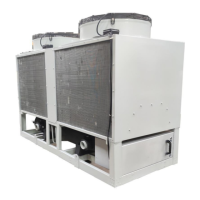
Basic components used in Kirloskar Chillers make KAC (air cooled) units are:
Hermetic scroll compressor
Air-cooled condenser in KAC units
Electronic expansion valve
Shell-and-tube direct expansion type liquid chiller / evaporator
Control panel
System Accessories and
Refrigerant, piping and Miscellaneous


 To Next Page