5.3 Inspection before battery recharging
Before recharging a battery, check its appearance: Deformation/Shell damage/Leakage
06
Stick Logger Quick Guide
Step 1: Scan the QR Code on the right side and download the APP.
6.1 Download APP
6.2 Stick Logger Installation
SOLARMAN Business
for business
SOLARMAN Smart
for end user
IPhone:Search “SOLARMAN Smart” in Apple Store.
Android:Search “SOLARMAN Smart” in Google Play.
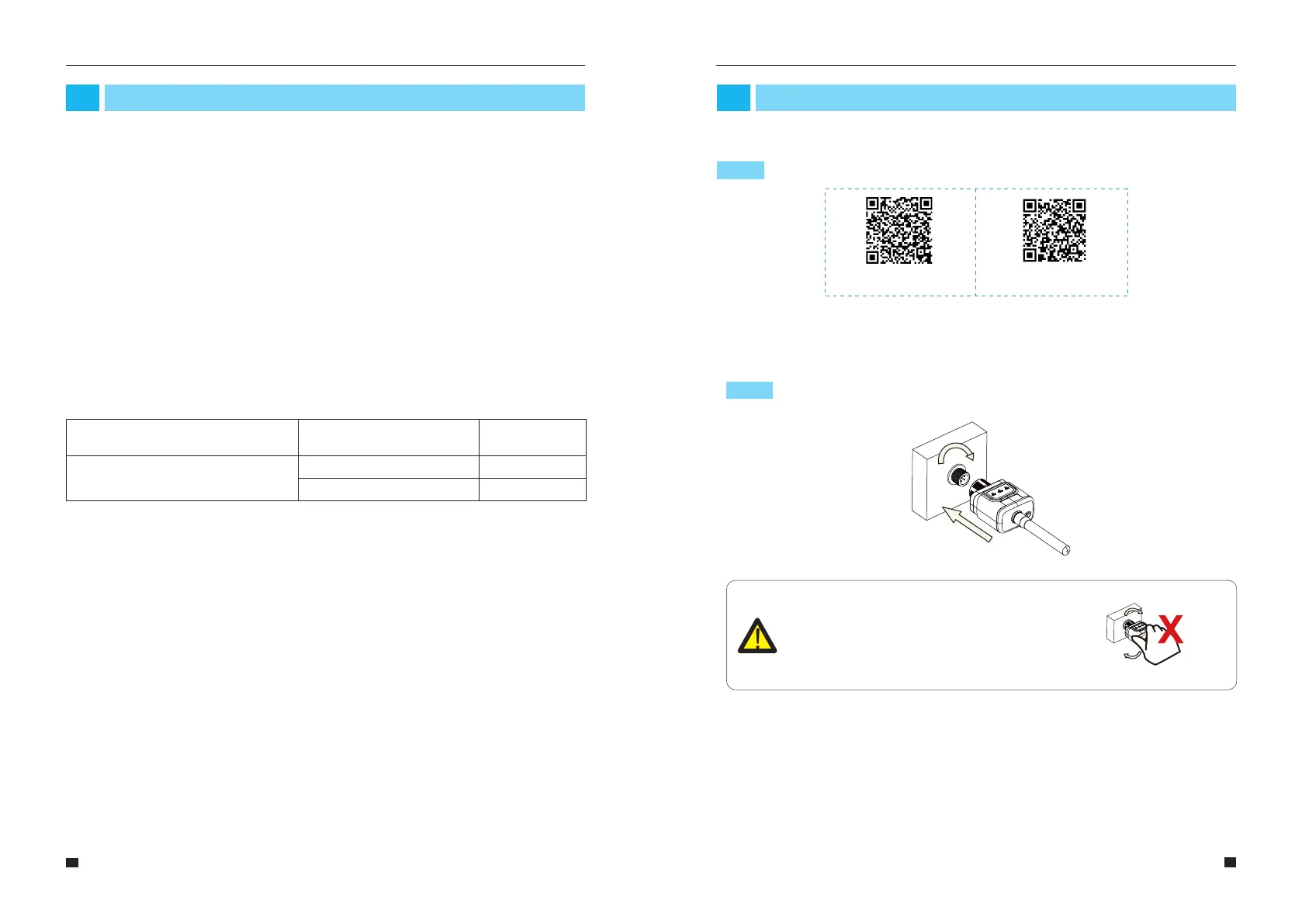
Step 1: Assemble logger to the inverter communication interface as shown in the diagram.
Please do not hold the logger body to rotate while install
or remove the logger.
Warning
59
60
User Manual User Manual
05
Battery Storage and Recharging
5.1 Battery storage requirements
1. Storage environment requirements:
–Ambient temperature: -10℃~45℃; recommended storage temperature: 20℃~30℃;
–Relative humidity: 0%RH~95%RH(No condensation);
–In a dry, ventilated and clean place;
–No contact with corrosive organic solvents, gases and other substances;
–No direct sunlight;
–Less than 2 meters from any heat source.
5.2 Storage expirations
In principle, it is not recommended to store the battery for a long time. Be sure to use it in time.
The stored batteries should be disposed according to the following requirements.
Table 5.2 Stored lithium battery recharging interval
Required Storage Temperature Actual Storage Temperature
Recharging
Cycle
-10℃~+45℃
-10℃≤T≤30℃
30℃<T≤45℃
12 months
8 months
1.If a battery is deformed, broken or leaking, discard it immediately regardless of its storage
time.
2.The allowable maximum stored battery recharging period is 3 years and the allowable
maximum stored battery recharging times is 3. For example, if recharging is performed once
every 8 months, the allowable maximum recharging times is 3 times; if recharging is
performed once every 12 months, the allowable maximum recharging times is 3 times; if the
allowable maximum stored battery recharging period or times is exceeded, it is recommended
to discard the battery.
3.A lithium battery will have its capacity decreasing after being stored for a long time, and
typically will have its capacity irreversibly decreasing by 3%~10% after being stored at the
recommended storage temperature for 12 months. If the customer conducts the discharge test
and acceptance according to the specification, there is a risk that the battery with a capacity
less than 100% after being stored will fail the test.



 To Next Page