RIGGING / SAILS
33
3
RIGGING / SAILS
l
TRIMMING WHEN CLOSE HAULED (between 75 and 50° of true wind)
Wind force given in apparent wind
- From 0 to 16 knots: full sail; sheet traveller 30 cm above the centre
line of the boat, mainsail sheeted with a slightly open leech (boom on
the centre line of the boat).
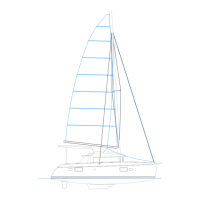
The jib is trimmed so that it skims the spreader, the jib traveller is set
so that the angle of the jib sheet is the continuation of a straight line
that goes through the sheet clew and the luff, at 40% of its height.
- From 16 to 20 knots: full sail; the sheet traveller goes up 60 cm
above the centre line of the boat, mainsail sheeted with a leech a
little more open (boom always in line: therefore you must ease off the
sheet). The jib traveller remains at the same place but the sheet is
adjusted so that the leech is 10 cm far from the spreader.
- From 20 to 26 knots: 1 reef, full jib; the sheet traveller goes back to
30 cm above the centre line of the boat.
The jib traveller remains at the same place but the sheet is eased off
so that the leech is 20 cm far from the spreader.
- From 26 to 30 knots: 1 reef, 75% of the jib; the sheet traveller goes
up 60 cm above the centre line of the boat.
The jib traveller remains at the same place or slightly goes forward
but it is adjusted so that the leech makes a propeller shape where the
upper part let some air go off in increases of wind.
- From 30 to 36 knots: 2 reefs, 60% of the jib; the sheet traveller
is back 30 cm above the centre line of the boat, the sheet is 50 cm
eased off and the boom is leeward.
n 3.1 Sailing
l
BEWARE
A catamaran is about 6 times more resistant to heeling than a
monohull.
In naval architecture, it is referred to as uprighting moment
multiplication of the weight of the boat by the transversal distance
between the centre of gravity and the centre of flotation (or bottom).
See the illustration on the opposite page.
This fact has real consequences as for the sailing and sail trimming
of a catamaran.
The fact that the boat does not heel may mask overcanvassing, which
may be very dangerous for the crew and the boat. Therefore you must
permanently keep a close eye on the speed of the true wind, and trim
the sail surface according to the latter as a matter of priority.
The below-mentioned trims apply in a calm sea. When the sea is
brown, you shall reduce earlier by 10% as far as the speed of true
wind is concerned. And as a general rule, it is absolutely imperative to
permanently try to ease up the boat rather than to stress her.
You will always try to have the forward edges of the sails facing the
apparent wind, and to have the sail not sheeted home, so that the
airflow behind the sail may be laminar, that is to say so that it may go
off the aft part of the sail without any disruption.
In case you shouldn’t follow the recommendations below, it might be
dangerous for the boat and the crew, and, in case of an accident, the
manufacturer’s responsibility would not be involved.
LAGOON 39



 To Next Page