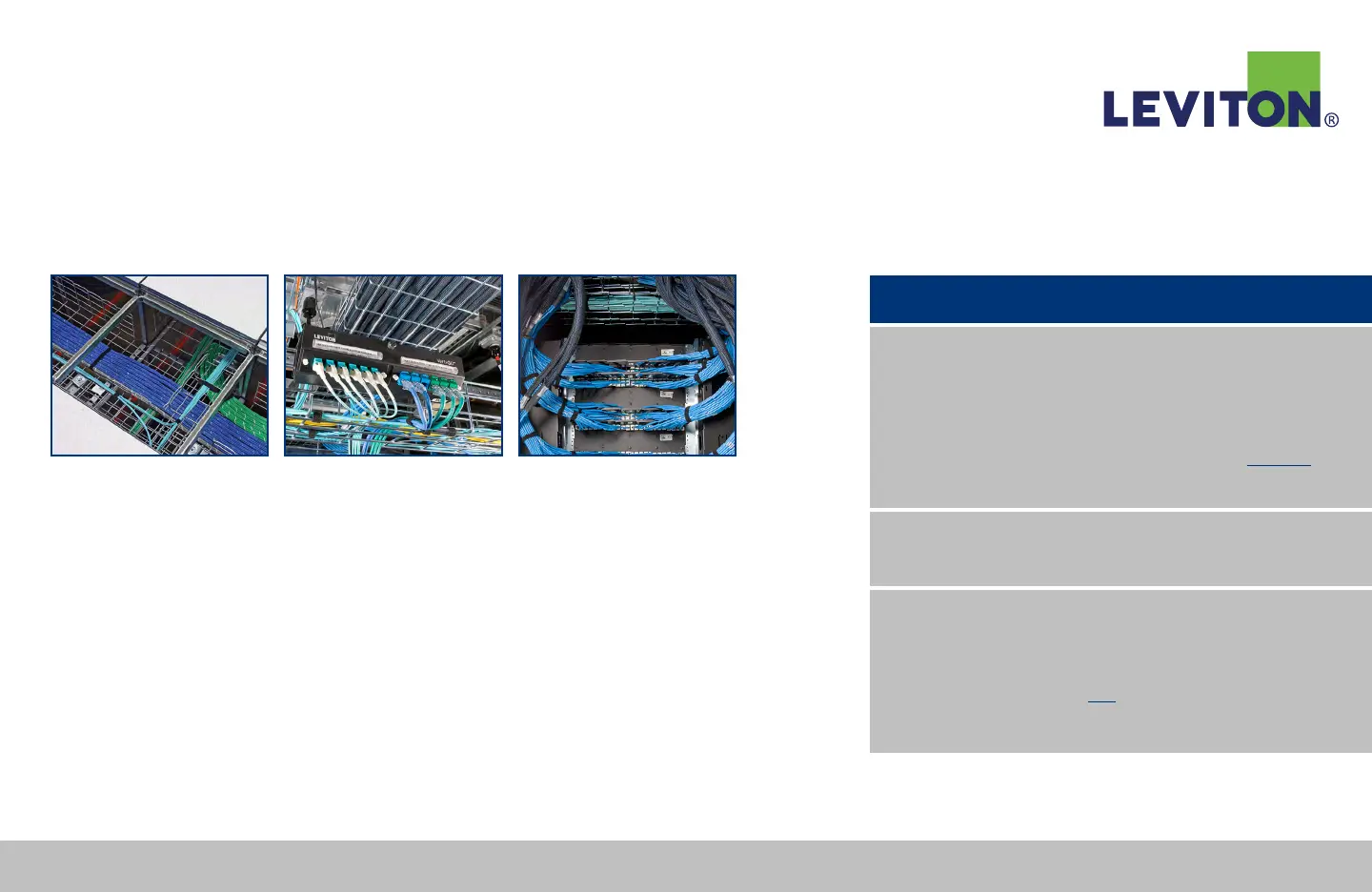
Data Centers — Raised Floor vs. Overhead Cable Runs
There are three typical data center Cat 6A cable run configurations: power and data
cabling both under a raised floor, both overhead, or power below and data overhead.
The chosen configuration will affect other data center design elements:
• If power and communications cable are both overhead, cable trays must be properly
sized, separated, and configured to support 6A cables and accommodate power runs.
• If both are underfloor, pedestals must be higher to accommodate larger 6A cables,
room for expansion, segregation from power runs, and proper airflow.
Pathways should be sized for 25% initial fill ratio, which
allows space for up to 50% fill with future additions.
Pathways should be no more than 6" (15 cm or 150 mm)
deep; larger deployments may use multiple trays or
pathways to support cabling requirements. See page 18
for cable tray sizing in pathways.
INSTALLATION BEST PRACTICES
Leviton trunks are pre-terminated with either a jack
or plug. There are numerous advantages to using
pre-terminated trunks, including factory testing.
See this application note (pdf) for how to select the
right copper trunk cables.
Space cable bundle supports every three to four feet
(0.9-1.2 meters) at irregular intervals.
Leviton Network Solutions
|
(800) 722 2082
|
+1 (425) 486 2222
|
leviton.com/ns 35
Raised Floor vs. Overhead Cable Runs
Applications
Applications


 To Next Page