lead to higher insertion loss, and in turn shorter permissible cable lengths. It can also increase bit error
LEVITON.COM/NS | 800.722.2082 / +1.425.486.2222
1
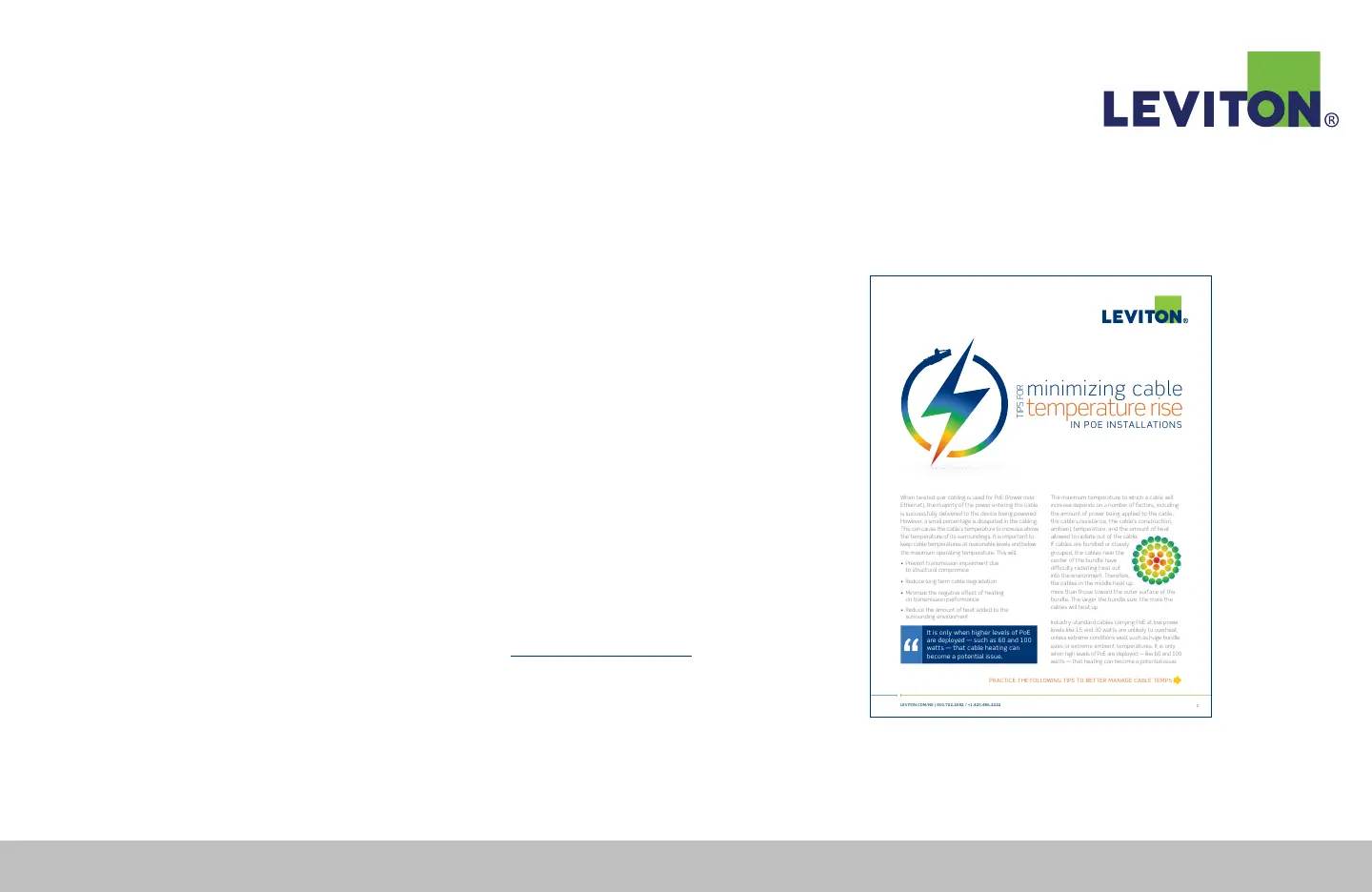
The maximum temperature to which a cable will
increase depends on a number of factors, including
the amount of power being applied to the cable,
the cable’s resistance, the cable’s construction,
ambient temperature, and the amount of heat
allowed to radiate out of the cable.
If cables are bundled or closely
grouped, the cables near the
center of the bundle have
difficulty radiating heat out
into the environment. Therefore,
the cables in the middle heat up
more than those toward the outer surface of the
bundle. The larger the bundle size, the more the
cables will heat up.
Industry-standard cables carrying PoE at low power
levels like 15 and 30 watts are unlikely to overheat,
unless extreme conditions exist such as huge bundle
sizes or extreme ambient temperatures. It is only
when high levels of PoE are deployed — like 60 and 100
watts — that heating can become a potential issue.
When twisted-pair cabling is used for PoE (Power over
Ethernet), the majority of the power entering the cable
is successfully delivered to the device being powered.
However, a small percentage is dissipated in the cabling.
This can cause the cable’s temperature to increase above
the temperature of its surroundings. It is important to
keep cable temperatures at reasonable levels and below
the maximum operating temperature. This will:
• Prevent transmission impairment due
to structural compromise
• Reduce long term cable degradation
• Minimize the negative eect of heating
on transmission performance
• Reduce the amount of heat added to the
surrounding environment
temperature rise
IN POE INSTALLATIONS
TIPS FOR
minimizing cable
It is only when higher levels of PoE
are deployed — such as 60 and 100
watts — that cable heating can
become a potential issue.
PRACTICE THE FOLLOWING TIPS TO BETTER MANAGE CABLE TEMPS


 To Next Page