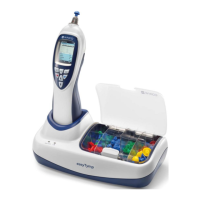
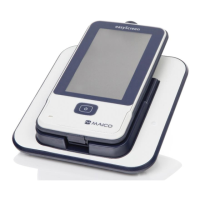
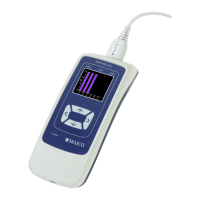
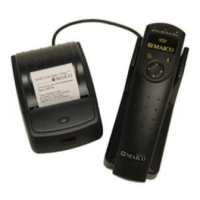
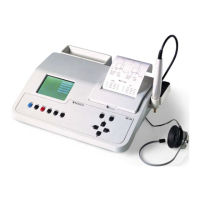
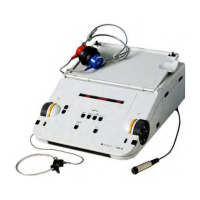
easyTymp® Operating Manual
32
Impedance Calibration Properties
Probe Tone:
Probe Tone:Probe Tone:
Probe Tone:
Frequencies: 226 Hz ±1%, 1000 Hz ±1%
Level: 85 dB SPL ±1.5dB measured in an IEC 60318-5
Acoustic coupler. The level is consistent for all
volumes in the measurement range.
Distortion: Max 5% THD
Compliance:
Compliance:Compliance:
Compliance:
Range: 0.1 to 8.0 ml
Temperature
Dependence: -0.003 ml °C
Pressure
Dependence: -0.00020 ml/daPa
Reflex Sensitivity 0.001 ml is the lowest detectable volume change
Temporal Reflex
Characteristics:
= 35ms (±5ms)
Rise Time = 45ms (±5ms)
Terminal Latency = 35ms (±5ms)
Fall Time = 45ms (±5ms)
Overshoot = Max. 1%
Undershoot = Max 1%
Pressure
PressurePressure
Pressure
Range: -300 to +200 daPa
Safety Limits: -750 daPa and +500 daPa, ±50 daPa
Reflex calibration standards and spectral properties:
General:
General:General:
General:
Specifications for stimulus and audiometer signals are made to follow IEC
60645-5
Ipsilateral Earphone
Ipsilateral EarphoneIpsilateral Earphone
Ipsilateral Earphone
Pure Tone: Interacoustics Standard
Wide Band Noise (WB) Interacoustics Standard
-Spectral Properties As “Board band noise” specified in IEC 60645-5, but
with 500 Hz as lower cut-off frequency.
General about levels The actual sound pressure level at the eardrum will
depend on the volume of the ear. See table 2 on pg.
33 for details.
The risk of artifacts at higher stimulus levels in reflex measurements are minor and will not
activate the reflex detection system.


 To Next Page
 Loading...