1-26
J
K
L
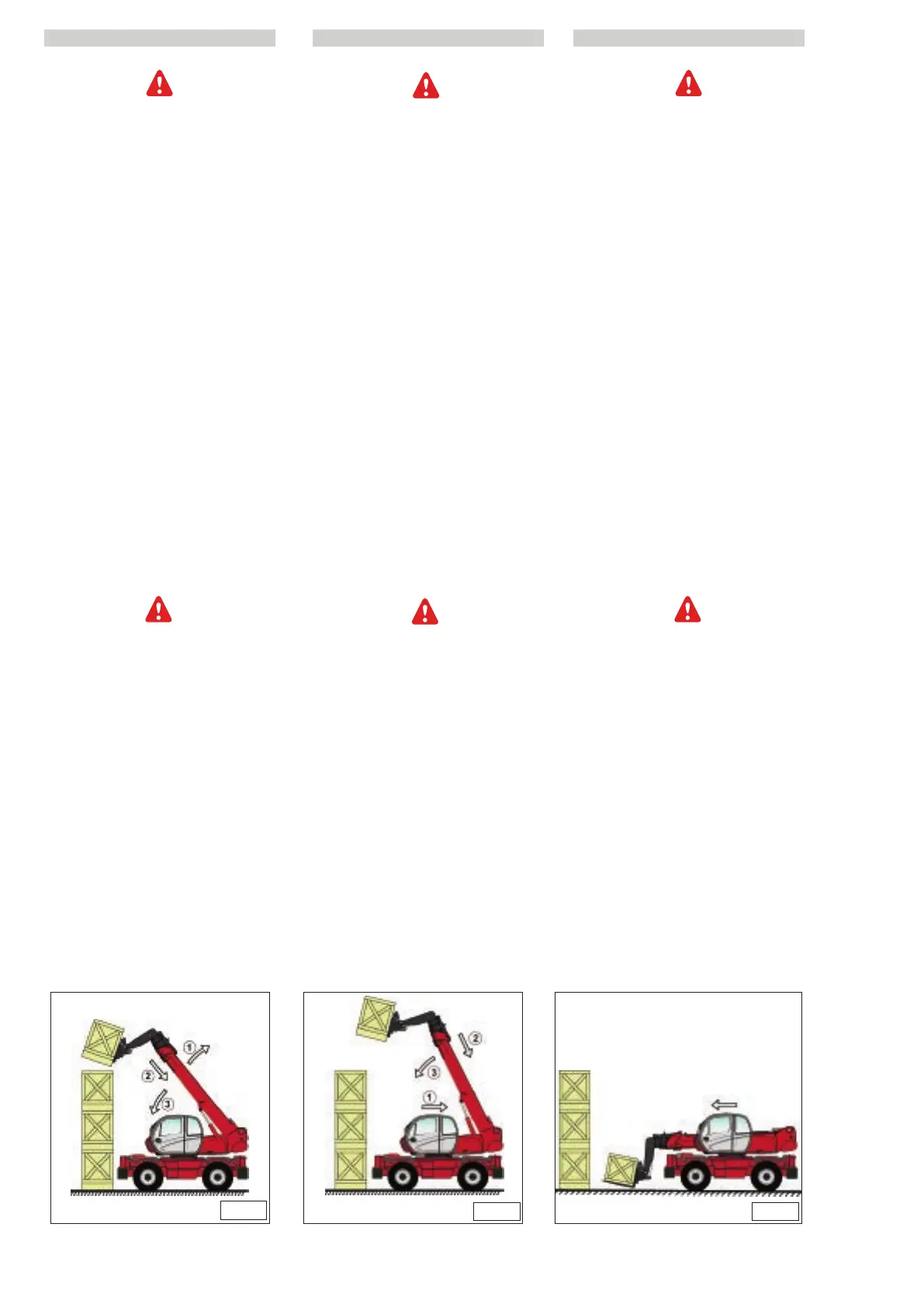
Inclinare sufficientemente il carico all’in-
dietro per assicurarne la stabilità (perdita
del carico durante la frenata) facendo
però attenzione a non modificarne l’equili-
brio.
- Se possibile (Fig. J), abbassare il carico
senza spostare il carrello elevatore.
Alzare il braccio (1) per allontanare il
carico, far rientrare (2) e abbassare il
braccio (3) per portare il carico in
posizione di trasporto (Fig. L).
- Se ciò non fosse possibile, arretrare il
carrello elevatore (Fig. K). Manovrando
molto dolcemente e con estrema
prudenza (Vedi paragrafo : E - VISIBILITÀ
nel capitolo : ISTRUZIONI PER LA
MOVIMENTAZIONE relativo alla visibilità
sul percorso), arretrare il carrello
elevatore (1) per allontanare il carico, far
rientrare (2) e abbassare il braccio (3)
per portare il carico in posizione di
trasporto (Fig. L).
D - Posare un carico in alto su
pneumatici.
È tassativamente vietato depositare un
carico se il carrello elevatore non è in
piano (Vedi paragrafo : G -
ORIZZONTALITÀ DEL CARRELLO ELEVATO-
RE, nel capitolo : MOVIMENTAZIONE DI
UN CARICO).
it
Tilt the load sufficiently backwards to
ensure its stability (loss of load on braking)
without upsetting the balance of the load
in so doing.
- If possible (Fig. J) lower the load without
shifting the lift truck. Lift the jib (1) to
release the load, retract (2) and lower the
jib (3) to bring the load into the transport
position (Fig. L).
- If this is not possible, back the lift truck
up. (Fig. K) Manoeuvring very gently and
carefully (See paragraph : E - VISIBILITY
in the chapter : HANDLING
INSTRUCTIONS for visibility of the road),
back up the lift truck (1) to release the
load, retract (2) and lower the jib (3) to
bring the load into the transport position
(Fig. L).
d
- Laying a high load on tyres
Under no circumstances should you lay
down a load if the lift truck is not a hori-
zontal position. (See paragraph : G - HORI-
ZONTAL POSITION OF THE LIFT TRUCK in
the chapter : LOAD HANDLING).
en
Ładunek przechylić do tyłu na tyle, by
zapewnić jego stabilność (i uniemożliwić
jego spadnięcie podczas hamowania).
Zwrócić uwagę na to, aby nie wpłynąć na
jego równowagę.
- Jeśli to możliwe (Rys. J), opuścić ładunek
nie przesuwając wózka podnośnikowego.
Podnieść wysięgnik (1), aby odsunąć
ładunek, wciągnąć go (2) i obniżyć (3),
aby ustawić ładunek w pozycji transportu
(Rys. L).
- Jeśli to niemożliwe, cofnąć wózek
podnośnikowy (Rys. K). Operując bardzo
powoli i z dużą ostrożnością (zobacz
punkt E - WIDOCZNOŚĆ w rozdziale
INSTRUKCJE NA TEMAT
MANEWROWANIA, dotyczący widoczności
drogi) cofnąć wózek podnośnikowy (1),
aby odsunąć ładunek, wsunąć (2) i
obniżyć wysięgnik (3), aby ustawić
ładunek w pozycji transportu (Rys. L).
D - Odkładanie na oponach ładunku
ustawianego wysoko.
Kategorycznie zabrania się odkładania
ładunku, jeśli wózek podnośnikowy nie
jest ustawiony poziomo (zobacz punkt G -
USTAWIENIE WÓZKA PODNOŚNIKOWEGO
W POZIOMIE w rozdziale OPEROWANIE
ŁADUNKIEM).
pl
648870 IT-EN-PL (04/05/2015)






 To Next Page