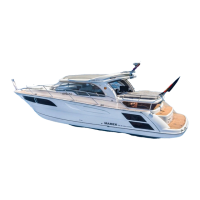
MAREX 375
4
by Nikl Design USER MANUAL
1.0 GENERAL INTRODUCTION
This manual has been compiled to help you to operate your craft with safety and
pleasure. It is not a course on boating safety or seamanship. If this is your first boat, or
if you are changing to a type of boat you are not familiar with, for your own comfort and
safety, please ensure that you obtain handling and operating experience before
“assuming command” of the boat.
Ensure that the anticipated wind and sea conditions will correspond to the design
category of your boat, and that you and your crew are able to handle the boat in these
conditions. Even when your boat is categorized for them, the sea and wind conditions
corresponding to the design categories A, B and C range from severe storm conditions
for category A, to strong conditions for the top of category C, open to the hazards of a
freak wave or gust. These are therefore dangerous conditions, where only a competent,
fit and trained crew using a well maintained boat can satisfactorily operate.
This owner's manual is not a fully detailed maintenance or trouble-shooting guide. In the
case of difficulty, refer to the boat builder or his representative.
Always use trained and competent people for maintenance, fixing or modifications.
Modifications that may affect the safety characteristics of the boat shall be assessed,
executed and documented by competent people. The boat builder cannot be held
responsible for modifications that have not been approved.
Always maintain your boat properly and make allowance for the deterioration that will
occur in time and as a result of heavy use or misuse of the boat.
Any boat, no matter how strong it may be, can be severely damaged if not used properly.
This is not compatible with safe boating. Always adjust the speed and direction of the
boat to sea conditions.
The boat should have appropriate safety equipment (lifejackets, harness, etc.) on board
according to the type of boat, weather conditions, etc. This equipment is mandatory in
some countries. The crew should be familiar with the use of all safety equipment and
emergency manoeuvring (man overboard recovery, towing, etc.), sailing schools and
clubs regularly organize drill sessions.
All persons should wear a suitable buoyancy aid (life jacket/personal floatation device)
when on deck. Note that, in some countries, it is a legal requirement to wear a buoyancy
aid that complies with their national regulations at all times.
The owner’s manual is written according to the following standard:
EN-ISO-10240:2004.



 To Next Page