1-1
SECTION I PROFILING
MEAN VELOCITY ( ) DEFINITION
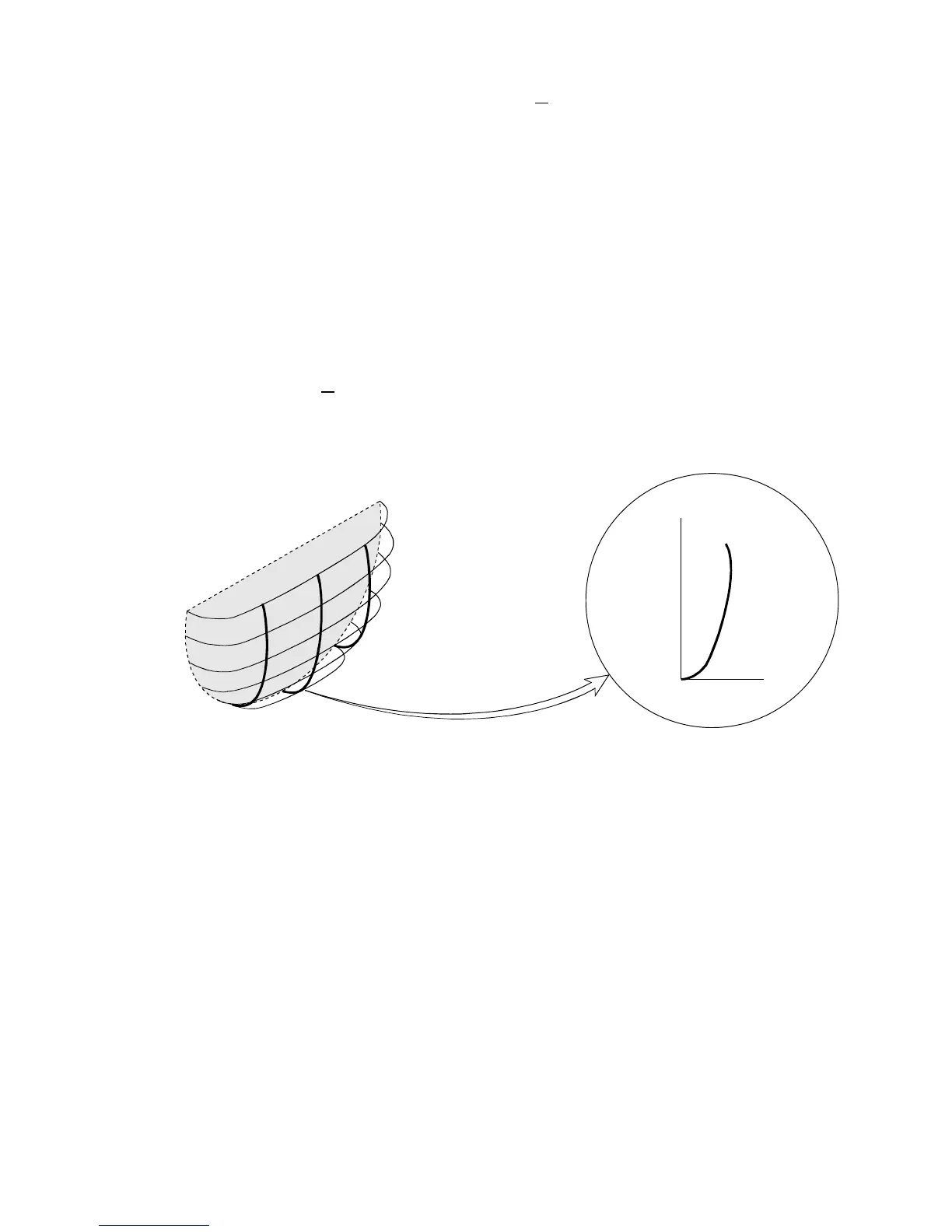
A particle of water near the conduit wall will not move as fast as a particle toward the center. To
understand this, we need to look at the molecules of moving liquids. The first layer of molecules
stick to the wall of the conduit. The next layer will move by sliding across the first layer. This
happens throughout the flow with each successive layer moving at a faster velocity. The change in
velocity is greater near the conduit wall than it is toward the center. If velocity measurements of
each layer could be taken, a velocity profile similar to the one in Figure 1-1 would be produced.
Notice that the velocity decreases near the surface. Since most flows fit this profile, this is called the
typical profile. There are, however, situations which will cause other profile shapes and it is usually
more difficult to calculate flow with these shapes.
To calculate flow, an average or mean of all the varying velocities must be determined. Since it is
not practical to measure the velocity of each layer of molecules, methods have been developed by
which a mean velocity ( ) can be determined from velocity measurements taken at a number of
positions in the flow.
CROSS-SECTIONAL AREA
The cross-sectional area of the flow is determined from a level measurement and the channel shape.
It is important that the mean velocity measurement and the level measurement is done at the same
location in the channel.
U
U
VELOCITY
D
E
P
T
H
Figure 1-1. Typical Profile


 To Next Page