2-6
RIVERS AND STREAMS
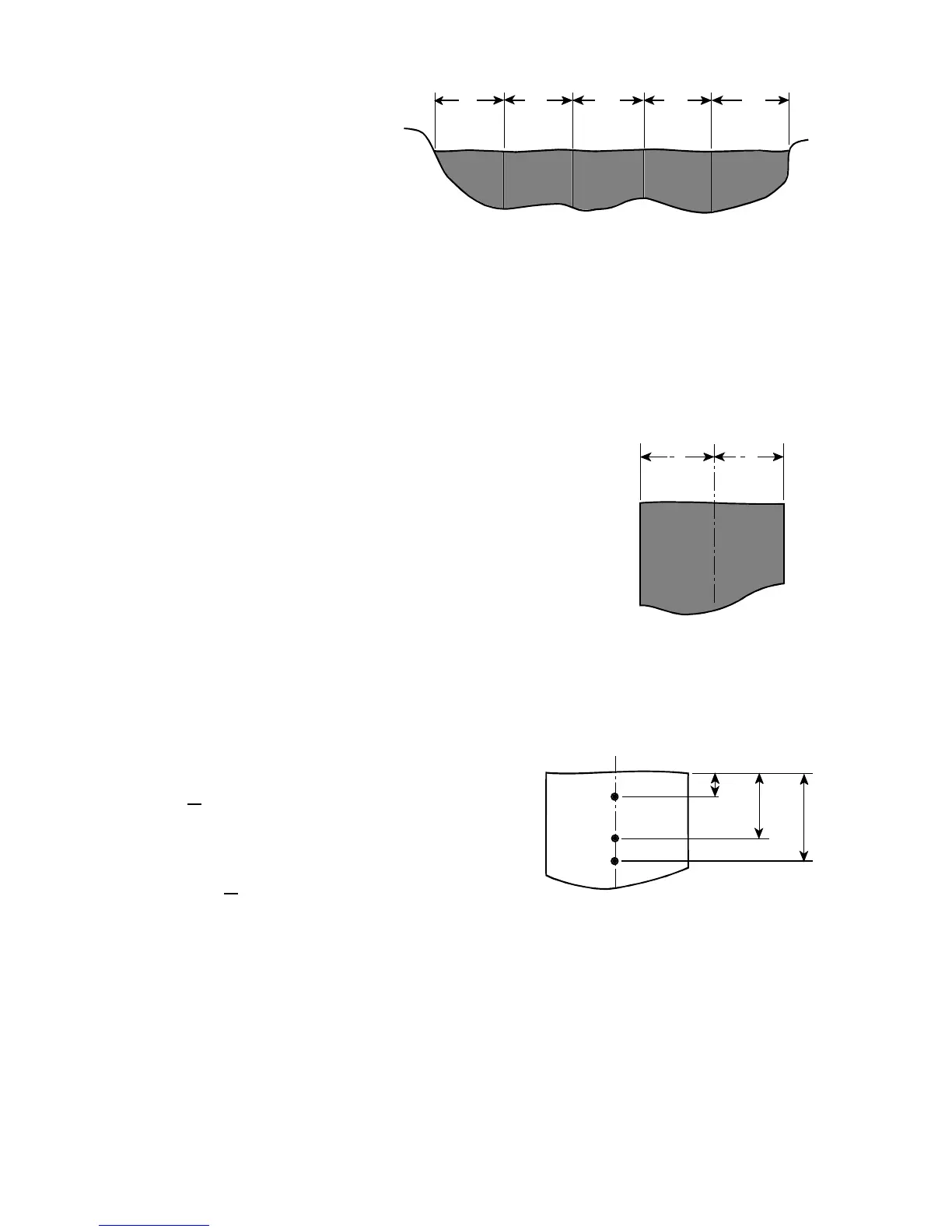
You will need to divide the width of the
channel into equal segments (Figure 2–1).
Then do a velocity profile and calculate the
flow for each segment. Sum the segment
flows for the total flow. The procedure for
calculating flows in rivers and streams is as
follows:
Comment:
The smaller the segment the better the result. If you find that the difference in mean velocity between
two adjacent segments is greater than 10%, the segments should be smaller.
• Divide the channel width into segments of equal length (d) (Figure 2-1).
• Locate the center line of each segment at
1
¦
2
d (Figure 2-2).
• Measure segment depth on the segment center line.
Comment:
The .2, .6, and .8 positions for rivers and streams are measured from the
surface. All depth and velocity measurements must be on the same plane.
• Calculate the .2, .6, .8 velocity positions on the segment centerline by:
.2 x Depth
.6 x Depth
.8 x Depth
• Measure the velocity at the .2, .6, and .8 positions.
• Average the .2 and .8 velocities.
• Average the .6 velocity with the average of the .2 and .8
velocities for .
• Calculate segment areas (Figure 2-4).
• Calculate the flow of each segment by:
Segment Area x .
• Sum the flow of the segments for total flow.
0.2
0.6
0.8
Figure 2-3. Velocity Profile
U
1
2
d
1
2
d
Figure 2-2. Segment
Centerline
U
d
1
d
2
d
4
d
5
d
3
Figure 2-1. Segment Length


 To Next Page