1-4
.4 Method
A simplified version of the .2, .4, .8 method is to measure the velocity at the .4 position and use this
as . This method is probably the least accurate because it uses only one data point and assumes
that a logarithmic profile exists. This is also called the 60% of depth method.
2-D Method
• Locate the center line of the flow.
• Locate vertical velocity lines (VVL) halfway between the
center line and the side walls of the conduit. This is measured
at the widest part of the flow.
• Take at least seven velocity measurements at different depths
along the center line.
• Take velocity readings at different depths on the VVL. The
distance between these depths should be the same as those on
the center line.
• Take final point velocity readings at the right and left corners of the flow.
• Check the data for any outliers. If a best fit curve of the velocity profile were plotted, an outlier
would lie outside the best fit curve region. See Figure 3-1 on Page 3-2.
• Average all measurements except outliers for . Remember to include the corner measurements.
2-D Method Alternate
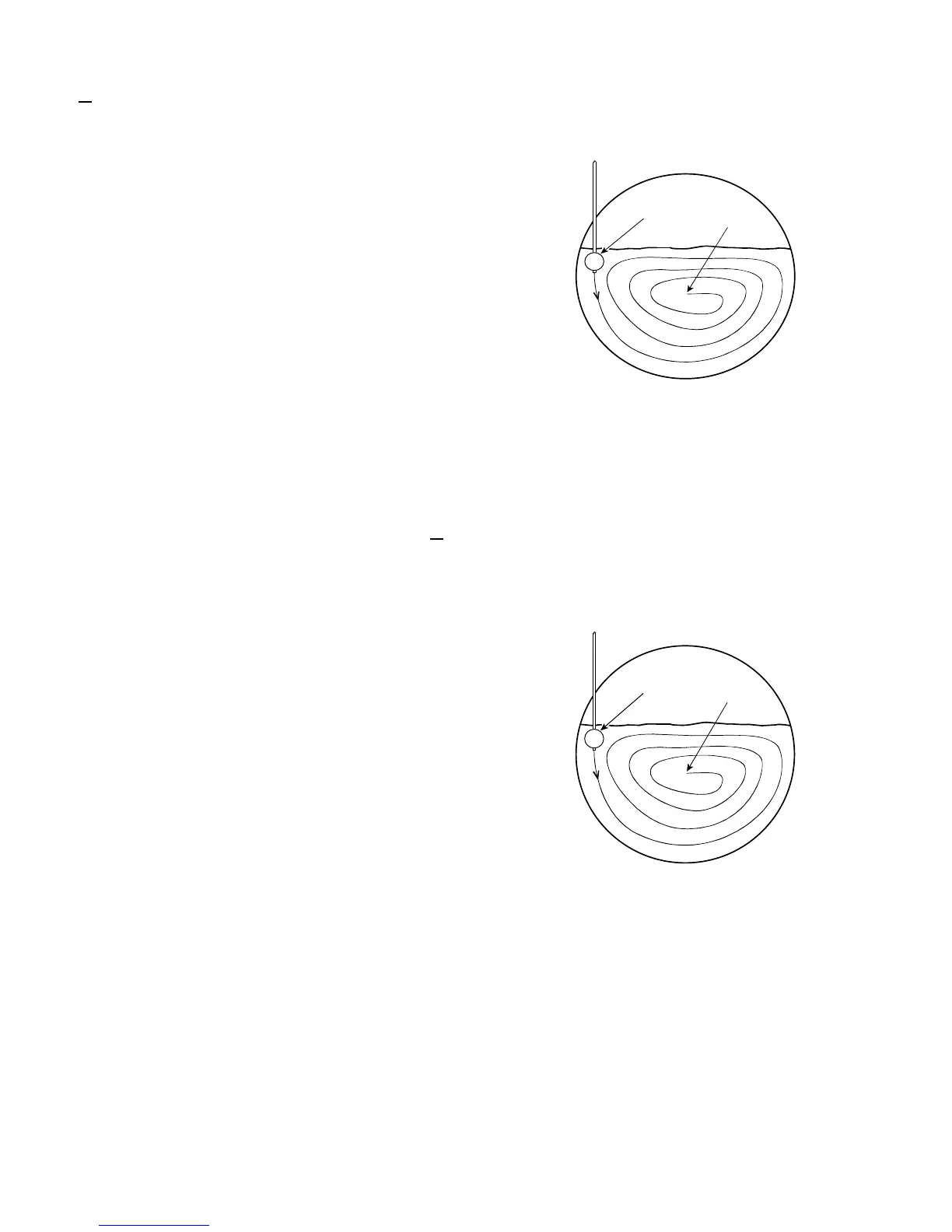
Another way to do the 2-D profile is with the FPA (fixed point
average) feature of the Model 2000 Flo-Mate. The Flo-Mate
sensor is moved at a constant velocity in a pattern across the flow
that covers the cross-sectional area. The velocity displayed by the
Flo-Mate at the end of the FPA period is the mean velocity.
Comment:
It may take several attempts to get the FPA time set so that the end
of the FPA period coincides with the end of the sensor motion.
• Set the FPA time to the appropriate number of seconds.
• Place the sensor at the start position and wait for a few sec-
onds.
• Press <ON/C> and start moving the sensor.
U
START
FINISH
START
FINISH
Figure 1-3. 2-D Velocity
Positions
Figure 1-4. 2-D Method
Alternate
U


 To Next Page