3-1
SECTION III
A PROFILING EXAMPLE
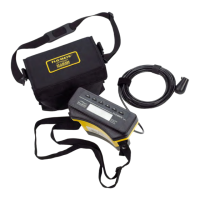
USING THE MMI MODEL 2000
This section illustrates how to collect and analyze data from circular conduits and achieve the best
possible accuracy. The data shown in this section is actual field data that was collected with a MMI
Model 2000 in a normal flow.
Comment:
A 2-D profile is used to collect the field data since this method provides the most point velocity
measurements. A centerline profile is plotted and a best fit curve is drawn. This permits all profiling
methods described in Section I to be utilized with one set of velocity measurements.
Collecting Field Data With the Model 2000
The 2-D Method
We start the 2-D profile on the vertical center line at the invert or bottom of the conduit. The first
velocity measurement with the Model 2000 is at 0.75 inches or 1.9 cm from the invert. This is
because the electrodes, which measure the point velocity, are 0.75 inches from the bottom of the
sensor. If the sensor is moved up 0.25 inches for the second velocity measurement, this will put the
electrodes one inch from the invert. The sensor can then be moved at even-inch or half-inch incre-
ments. Five to ten velocity measurements between the bottom and the surface are recommended.
After the vertical center line is profiled, the level is measured and recorded.
Next the right and left vertical velocity lines are profiled and recorded. Then the right and left corner
velocity measurements are taken and recorded. Finally the level is measured and recorded. We now
have the necessary data to calculate flow.
Comment:
If there is a sudden drop in velocity at any position, check the sensor for debris.


 To Next Page