1-3
Vertical drop (outfalls) - The 2-D method is recommended for outfalls. Remember to measure
the level on the same plane as the velocity profile. Outfalls should be
avoided wherever possible.
Nontypical profile shape - If you suspect a profile shape may not be typical, use the 2-D method.
PROFILING CHECKS
For best possible results, you should:
• Check the inside diameter of the conduit. Also, measure the horizontal and vertical diameters. If
there is a difference, then average the diameters.
• Check for symmetry of flow.
• Check level several times during the procedure.
• Check the invert for rocks, sediment, and other debris.
CALCULATING
PROFILING METHODS
0.9 x Umax Method
• Take a series of point velocity measurements throughout the entire flow.
• Identify the fastest velocity. In most cases, this is usually located in the center just beneath the
surface.
• Multiply the fastest velocity by 0.9 for .
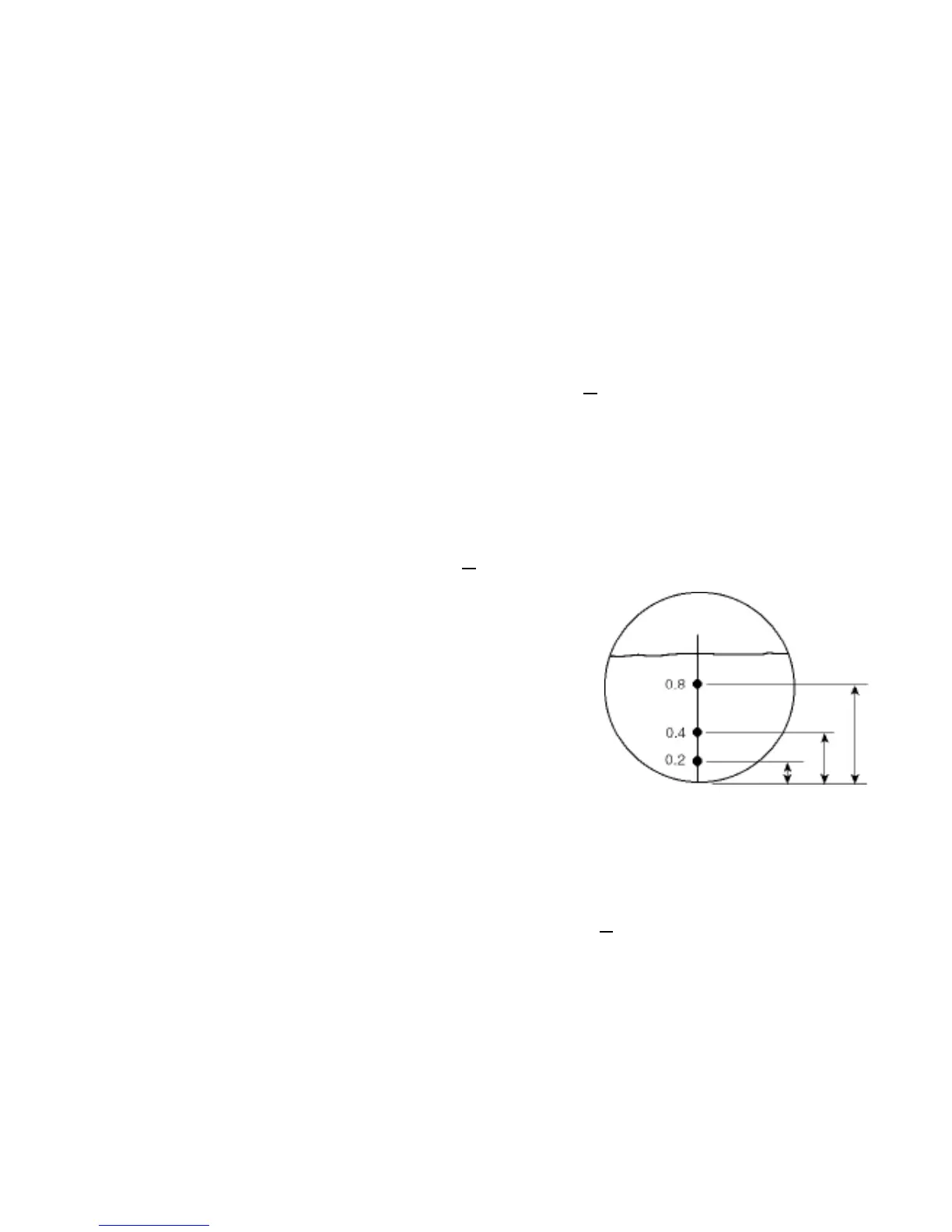
2, .4, .8 of Depth Method
• Measure depth of flow (Page 1-5).
• Calculate the positions on the centerline by:
0.2 x depth
0.4 x depth
0.8 x depth
• At the .2, .4, and .8 positions, measure and record the
velocities (Figure 1-2).
Comment:
In manmade channels, measure the .2, .4, and .8
positions from the bottom.
• Average .2 and .8 velocities.
• Average the .4 velocity with the .2 and .8 average for the .
Figure 1-2. (.2, .4, .8) Velocity
Positions
U
U
U


 To Next Page