Effects 17
E
FFECTS
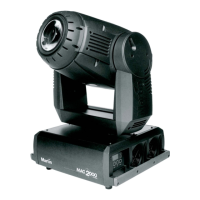
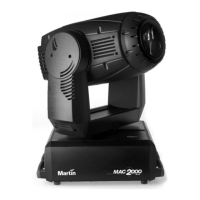
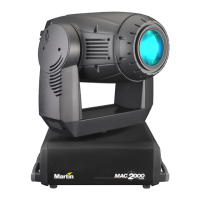
The MAC 2000 Wash is compatible with USITT DMX512 controllers. The fixture has two DMX operating modes,
8-bit and 16-bit.16-bit mode requires two more DMX channels than 8-bit mode but provides more precise pan/tilt
positioning. All other functions are identical. See “DMX protocol” on page 22.
Dimming and strobe
The mechanical dimmer/shutter system provides smooth, high-resolution 100 percent dimming, instant open and
blackout, random and variable strobe effects up to 10 Hz, and random and variable pulses in which the dimmer snaps
open and slowly dims or snaps closed and slowly opens.
Color mixing
The color mixing system uses continuous dichroic cyan, magenta, and yellow (CMY) color filters. It is a subtractive
system that removes color from white light. Inserting all three filters results in loss of light: for maximum brightness,
mix 2 colors at a time.
Two color wheels are provided, each with four removable positions for dichroic glass color filters and a position for a
direct pass through of the beam.
Color temperature correction
The color temperature correction (CTC) system uses a continuous 0 - 178 mireds color filter that lowers the color
temperature from 6000 K to 2900 K.
Focus and zoom
The zoom lens widens the beam from approximately 12° at full spot to 45° at full flood.
Power mode provides a high intensity 10° spot with no diffusion.
Pan and tilt
The yoke pans 540° and the head tilts 267°. For maximum positioning accuracy, select 16-bit mode.
The pan/tilt speed (fast, norm, or slow) may be selected on the pan/tilt speed channel. Setting the pan/tilt speed channel
to “blackout” causes the shutter to black out the light while the head is moving.
Speed control
There are two ways to control the speed at which effects move from one static position to another. These are known as
tracking control and vector control and are selected on the Pan/Tilt Speed and Effect Speed Channels. These channels
are independent so you may, for example, combine a vector control pan movement with a tracking control color fade.
In tracking mode, speed is determined by the cross-fade time. The controller continuously sends small position
changes that the fixture “tracks.” To enable tracking mode, set the relevant speed channel to a tracking value. Note that
in addition to enabling tracking control, some tracking values also provide overrides of the menu settings.
In vector mode, speed is set directly on a speed channel. The cross-fade time must be 0. Vector control provides a way
to set speed on controllers that do not have programmable fade times and results in smooth movement regardless of the
cross-fade time or the controller’s processing power.





 To Next Page