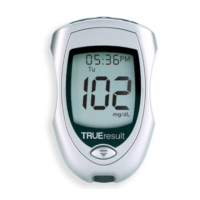
TRUEresult
®
Quality Assurance / Quality Control Manual
1
Safety Notice
ATTENTION: Pharmacy Staff, Nursing Staff, Laboratory Staff, and
Central Supply Staff – Reminder of Potential for Falsely
Elevated Blood Glucose Results due to Drug Interferences
This Safety Notice is for personnel involved in the issuance of point-of-care
blood glucose testing systems and personnel involved in actual point-of-care
blood glucose testing. Parenterally administered drugs containing or
metabolizing to maltose or galactose, and orally administered xylose can cause
falsely high blood glucose results with certain point-of-care blood glucose
monitoring systems that utilize the enzyme glucose dehydrogenase-PQQ
(GDH-PQQ) for the measuring of a blood glucose result.
Please note: The interferences described in this Notice may be seen with all
blood glucose monitoring systems that use GDH-PQQ methodology, regardless
of the manufacturer of the system.
The information regarding the limitations of using GDH-PQQ methodology may
or may not be included in the labeling of drugs containing or metabolizing
maltose, galactose, or xylose. It is important that all staff are aware of this
interference in order to prevent inappropriate treatment based on falsely elevated
blood glucose results. Staff must advise at-risk patients who use blood glucose
monitoring systems with GDH-PQQ methodology of these risks and the
consequences of inappropriate treatment.
Who is at risk?
Patients at risk for falsely elevated blood glucose results include those using
blood glucose monitoring systems utilizing glucose dehydrogenase-PQQ, and
who are:
• Peritoneal dialysis patients receiving dialysis solutions containing
icodextrin (e.g. Extraneal
®
, Icodial
®
) that is metabolized to maltose;
• Receiving injections or infusions of solutions containing galactose or
maltose (including some human immunoglobulin preparations
(e.g. Octagam
®
, WinRho
®
, SDF Liquid, HepaGam B
™
);
• Patients undergoing xylose absorption testing;
• Patients receiving intravenous solutions containing maltose as a
substitute for glucose or as a means for patient hydration;
• Patients receiving any drugs, including any investigational drugs and
those made by compounding pharmacies, which contain or metabolize
to maltose, galactose, or xylose (Orencia
®
, Adept
®
, Bexxar
®
).
Note: An At-Risk Patient Identification Notice located under Forms, Section
10, in this Manual may be used for easy identification of at-risk
patients.


 To Next Page