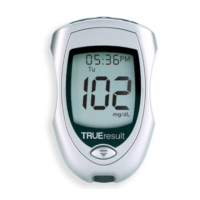
TRUEresult
®
Quality Assurance / Quality Control Manual
28
Blood Glucose Testing
Sample Information
Fresh, capillary whole blood from the finger or forearm is the recommended
sample to be used for testing blood glucose. Always check with the Doctor or
Diabetes Healthcare Professional before using a sample from the forearm.
Results from the forearm are not always the same as results from the fingertip.
Use fingertip instead of forearm:
- Within 2 hours of eating, exercise, or taking insulin,
- If the patient’s blood glucose may be rising or falling rapidly or their
results often fluctuate,
- If the patient is ill or under stress,
- If the glucose result may be low or high,
- If symptoms of low or high glucose levels may not be evident.
2
Note: Venous whole blood drawn in EDTA (purple top tube) or heparin (green
top tube) may be used for testing. Use venous blood within 30 minutes of
collecting for best results. Mix tube contents gently before using. Serum,
clotted blood, and plasma cannot be used with the TRUEresult System.
For evaluation where TRUEresult blood glucose results are compared to blood
glucose results given by a laboratory instrument, it is recommended that
capillary or venous whole blood obtained from the same sampling site be used
for both the laboratory instrument as well as the TRUEresult System. Laboratory
tests should be performed within 30 minutes of a blood glucose meter test to
minimize the changes in glucose values due to glycolysis. Results from the
TRUEresult System are considered accurate if within +
20% of laboratory
results. If patient has recently eaten, finger results from the TRUEresult System
can be up to 70 mg/dL higher than venous laboratory results.
3
The TRUEresult System cannot be used on neonates. Perform laboratory glucose
tests on critically ill patients.
WARNING!
TRUEtest Blood Glucose Test Strips utilize glucose dehydrogenase-PQQ
(GDH-PQQ). The TRUEresult System MUST NOT
be used for the following
patient conditions:
• Peritoneal dialysis patients receiving dialysis solutions containing
icodextrin (e.g. Extraneal
®
, Icodial
®
) that is metabolized to maltose,
• Injection or infusion of solutions containing galactose or maltose,
including some human immunoglobulin preparations
(e.g. Octagam
®
, WinRho
®
, SDF Liquid, HepaGam B
™
),
• Patients undergoing xylose absorption testing,
• Patients receiving intravenous solutions containing maltose as a
substitute for glucose or as a means for patient hydration,


 To Next Page