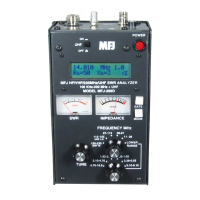
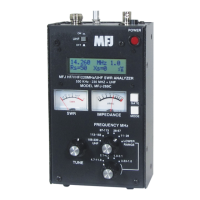
MFJ-269C Instruction Manual LF/HF/VHF/UHF SWR Analyzer
10
4.0 MAIN (OR OPENING) MODE
IMPORTANT WARNING: Never apply RF or DC voltages to the Antenna port of this unit. It uses zero
bias detector diodes that are easily damaged by any external voltages over a few volts. Also, confirm
the power supply voltage and polarity are correct, as described in Section-2.0.
A basic understanding of antenna theory and transmission line behavior will prove helpful for making the
best use of the data provided by your MFJ-259C. The ARRL Handbook and ARRL Antenna Book
provide concise peer-reviewed explanations that should suffice for most applications. When it comes to
the finer points of antenna design, there is (unfortunately) a fair amount of misinformation circulating on
the web and over the airwaves. When it comes to RF networks and antenna systems, there's no black
magic. Stick with the fundamentals as presented by credible professional sources.
4.1 General Connections
When conducting SWR and Impedance measurements, follow these practical guidelines:
1. Connectors: If connector transitions (RF adapters) are needed, use only high-quality parts and check
them for wear, oxidation, dirt, and tight pin contact before proceeding.
2. Lead Length: Make all connection electrically secure and keep all leads as short as possible. This
precaution is especially important when measuring electrical components that are not part of a 50-ohm
coaxial system.
3. Coaxial Cable: Always use good quality 50-ohm cable and connectors when making SWR
measurements. Contaminated, mismatched, or damaged cable will introduce significant error.
4. Calibration Plane: When making Complex Impedance measurements, (R+X) or (Z), remember that
any length of transmission line you install between the load and the analyzer will displace the load
from the analyzer's calibration plane.
For simple handheld analyzers like the MFJ-269C, the calibration plane is always located at the
analyzer's RF connector. This is the point where Zo=50 Ohms and Phase shift = 0 degrees. It is the only
test point where the analyzer will be calibrated for complex impedance measurements. Displacing the
load away from the analyzer's calibration plane through random lengths of coax should have little or no
impact on SWR readings, but will introduce significant error through phase shift and transformer action
to invalidate virtually any complex impedance measurement you might make.
When measuring Complex Impedance, always install the MFJ-269C as close (electrically) as possible
to the DUT (device under test)!
4.2 Antenna SWR and Impedance
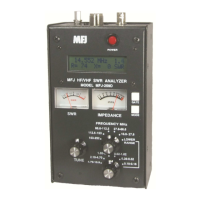
Use the N-Female Antenna connector located on top of the MFJ-269C for all RF measurements (except
those using the Frequency Counter mode). Follow the procedure outlined below for measuring SWR:
1. If your antenna doesn't have a dc-grounded feed system, momentarily short the cable's center conductor
to the shield immediately before connecting up to the analyzer. This simple procedure will discharge any
static buildup on the antenna and prevent damage to the analyzer's sensitive detector diodes.


 To Next Page