MFJ-269C Instruction Manual LF/HF/VHF/UHF SWR Analyzer
30
5.6.2 Coax Loss
Please re-read and apply the method presented in section 4.2.2 Coax Loss, before using this advanced
function. It explains the loss measurement in detail.
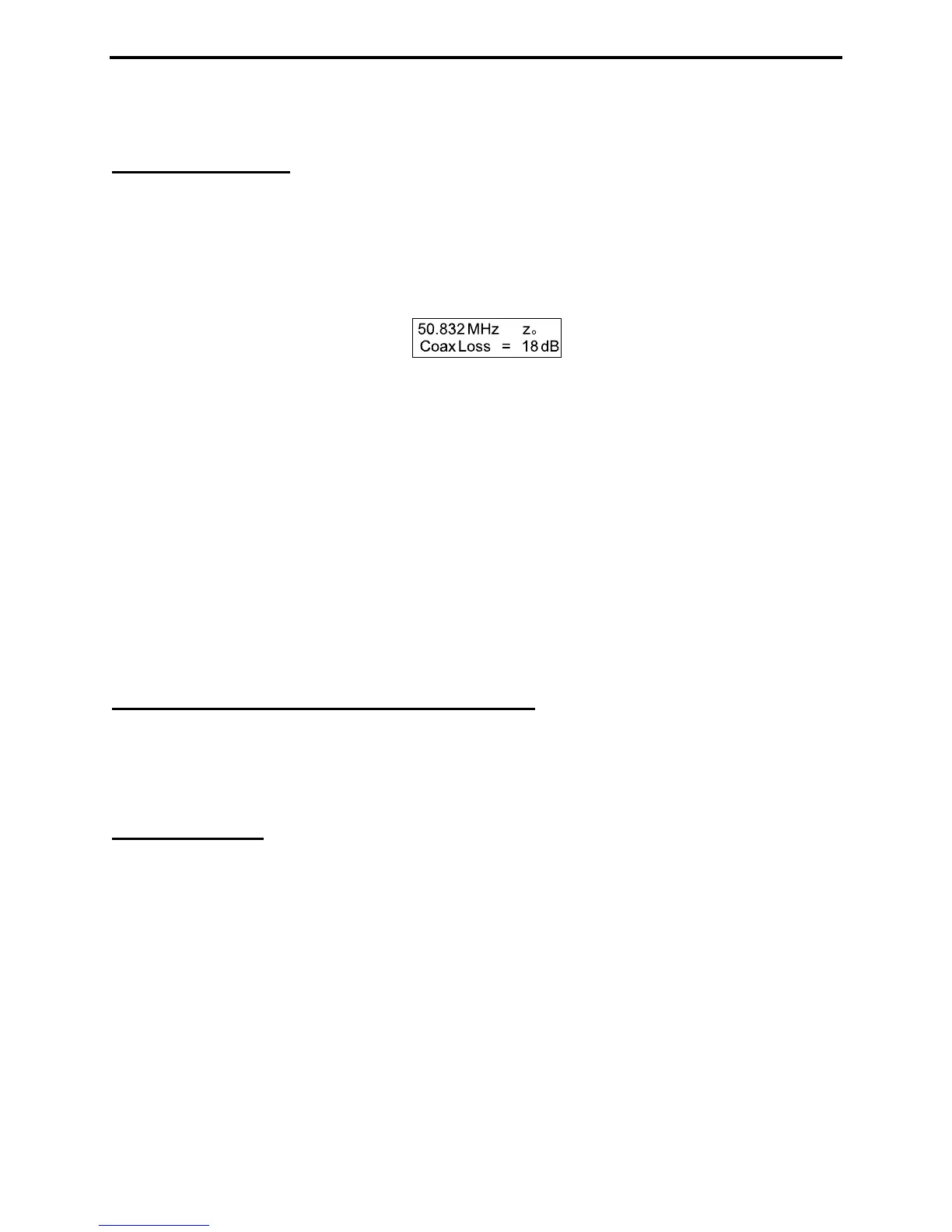
Access this mode via the Z Characteristic screen (5.6.1) by pressing Mode. In this mode, Zo flashes in
the upper right and Coax Loss appears on the display.
Coax Loss is measured for the feedline Zo selected in 5.6.1. It is important that the line is not terminated
with a short or a resistive (dissipative) load when making this measurement.
To use this mode, sweep the desired measurement frequency range. Watch the loss reading carefully, and
tune for minimum loss. The minimum loss reading near the desired frequency range is the correct loss
reading.
To return to Z Characteristic, press Mode. Pressing Gate returns the analyzer to the Zo setup menu.
Press and hold both Gate and Mode for an extended period to cycle the analyzer back to the Main or to
another Advanced mode.
6.0 ADJUSTING SIMPLE ANTENNAS
Most antennas are adjusted by varying element length -- and most homemade antennas are simple
verticals or dipoles that are easily adjusted.
6.1 Dipoles
Since a dipole is a balanced antenna, it is a good idea (and good engineering practice) to put a balun at the
feedpoint. The balun can be as simple as several turns of coax several inches in diameter, or a
complicated affair with many windings on a ferromagnetic core.
The height of the dipole, as well as it's surroundings, influence the feedpoint impedance and feedline
SWR. Typical heights result in SWR readings below 1.5 to 1 in most installations using 50-ohm coaxial
cable.
In general, the only adjustment available is the length. If the antenna is too long it will resonate low in
frequency, and if it is too short it will resonate high.
Remember feedline length, when the antenna is not exactly the same impedance as the feedline, modifies
the impedance along the feedpoint. SWR will remain constant (except for a small reduction in SWR as


 To Next Page