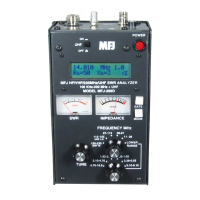
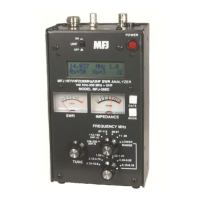
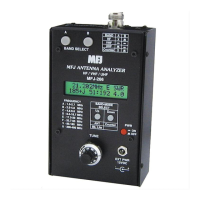
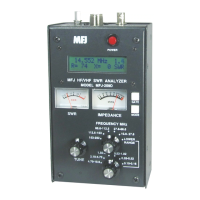
MFJ-269C Instruction Manual LF/HF/VHF/UHF SWR Analyzer
15
2. Connect the inductor (DUT) across the Antenna connector using the shortest leads possible, or with
the lead length normally used in your working circuit to include stray inductance in the measurement.
3. Adjust the VFO (Tune) to your frequency of interest. If an error sign comes up, choose the closest
frequency where no warning appears. The L(X=0) warning indicates the inductor looks like a near perfect
short to the analyzer's bridge and the frequency is too low (or the inductor too small) to measure. The
digital display and the analog Impedance meter both present the DUT's reactance (X) in ohms.
When measuring an inductor, its displayed value will sometimes change with the test frequency. This
happens because of stray capacitance between coil windings and in the leads going to the Antenna
connector. At RF, the value of an inductor (in uH) may appear substantially different from its "rated"
value that was determined at a lower frequency. With increasing frequency, measured inductance usually
increases and, at some high frequency, the coil may become self-resonant and appear as an open circuit
(or a trap) with infinite reactance. At some very low frequency, it may look like a short.
4.6 Frequency Counter (Function-5)
The Frequency Counter mode is the final Main Mode function. To access the counter from the opening
menu, press Mode four times (or if already in the Main menu, step through it until the Freq. Counter
screen appears.
Important Note: Never apply dc or more than 5 volts peak-to-peak to the BNC Frequency Counter
Input jack. In this mode, the Gate button controls the counter's time base window. As a general rule the
longer the window, the more accurate the frequency count. The accuracy of this counter is typically better
than 0.05 %. Note that sensitivity of the counter tends to decrease with higher frequency signals.
5.0 ADVANCED OPERATION
5.1 Forward
The advanced mode provides several special functions. Some functions are very useful, such as distance
to fault (HF/VHF) or transmission line length in degrees.
Measurement Notes: The Advanced menus present data in more "technical" or potentially unfamiliar
terms. Advanced- 1 includes impedance descriptions such as Magnitude and Phase of Load Impedance,
Series and Parallel Equivalent Impedance, Reflection Coefficient, and Resonance. Most of these terms
are useful in special applications, such as in adjusting matching stubs, but may not be useful for making
simple antenna adjustments. The advanced menus also contain uncommon terms describing basic SWR,
such as Return Loss and Match Efficiency. These, also, represent engineering terms that may prove
misleading because "label" may not imply what is actually happening in the RF system. If a concept or


 To Next Page