41
Anhydrous Ammonia (cont.)
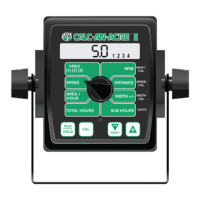
Console Operation
Refer to the console operator’s manual for most calibration
and operating procedures. Console rotary switch positions
have the same functions but TOTAL LIQUID is read as lbs/
kg of nitrogen.
Minimum flow rate should be set no lower the 8 lbs. (3.6 kg)
of nitrogen per minute. This sets the minimum application
rate at 480 lbs. (218 kg) of nitrogen per hour. If this number is
set lower, accuracy and system response times will probably
suffer.
Set your TARGET lbs/kg of nitrogen per area using the
TARGET SPRAY RATE as shown in the operator’s manual.
Read the applied lbs/kg of “N” per area using the SPRAY
RATE mode. Similarly, the DELTA feature can be used to
adjust lbs/kg of “N” per area. Selecting FLOW RATE will
display lbs/kg of nitrogen per minute.
TOTAL LIQUID will read out in lbs/kg of actual “N”. Scale slips
are usually in lbs/kg NH
. When comparing, remember to
either multiply the scale slip by .82 or to multiply the monitor
reading by 1.214. Flowmeter accuracy can be checked by
comparing scale slip to monitor reading and clearing TOTAL
LIQUID when changing tanks.
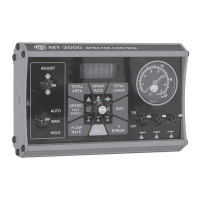
Enter the applicator width into the console’s left boom
calibration position. For MT-3000 operation, use the left
boom switch to control the electric shut-off valve. These
switches directly control the valve. All other switches
activate relays which could turn on in the event of electronic
component failure.
NOTE: NEVER USE THE MT-3000 CONSOLE PRESSURE
GAUGE WITH ANHYDROUS AMMONIA.
This gauge contains brass and is not compatible with NH
.
It is unsafe to bring any equipment containing NH
into the
operator’s area. Use a gauge approved for NH
installed on
the applicator’s manifold.
Field Operation
Always follow acceptable safety precautions. Make sure that
equipment is in good operating order. Before connecting
nurse tank to the applicator, check the electric shut-off valve
on the NH3500 for proper operation.
After changing nurse tanks or after other periods of long
shut-down, operate the system in MAN until the application
rate stabilizes. This allow the heat exchanger to reach
operating temperatures before selecting AUTO. Erratic
operation may be experienced if AUTO is selected before
operating temperature is reached.
Manifold pressure is very important for good distribution
of NH
. Use barbed fittings with properly sized orifices or
an adjustable manifold to maintain adequate pressure. If
manifold back-pressure is too low, vapor bubbles will be
allowed to enter flowmeter and readings will be inaccurate.
Typical manifold pressure ranges from 15 to 60 PSI (1
to 4.1 bar) depending on application rates and ambient
temperature.
In a hilly or rough conditions the nurse tank dip tube will
not remain submerged, allowing extra vapor in the system.
This vapor it too much for the heat exchanger to condense
and the system will exhibit erratic operation. If the dip tube
remains out of liquid, operation may appear to be normal,
but the system is simply metering vapor. If the system is
metering vapor, you will notice extremely low manifold
pressure. Change tanks before NH
level is low enough to
cause these problems.
In NH
control systems, location of the frost build-up is an
indication of system performance. The NH3500 system will
normally have frost on the output side of the servo valve
and in some cases, a small amount on the bottom portion of
the heat exchanger. Frost before the servo valve indicates
excessive pressure drop in the delivery system or restricted
vapor lines.
The strainer is a common source of excessive pressure drop
and should be cleaned regularly. AFTER COMPLETELY
DRAINING THE SYSTEM, remove the large plug and carefully
clean the strainer’s screen. Also, periodically check the vapor
tubes for obstructions.
!
WARNING
Always follow standard safety
procedures and use proper
safety equipment when working
on anhydrous ammonia equipment
Before working on plumbing:
• Disconnect nurse tank.
• Remove all ammonia from system
• Leave all valves on applicator open.


 To Next Page