Exhaust ducting
81
If the extractor is used at the
same time as a heating appliance
that relies on oxygen from the same
room, there is a risk of toxic fumes.
It is essential that the “Warning and
Safety instructions” are observed.
The extractor should be installed
according to local and national
building regulations. Seek approval
from the building inspector where
necessary.
The extractor has an exhaust
connection of 222x89mm.
Only use smooth pipes or flexible
ducting made from approved non-
flammable materials for exhaust
ducting.
To achieve the most efficient air
extraction with the lowest noise
levels, please note the following:
– The cross-section of the exhaust
ducting must not be smaller than the
cross-section of the exhaust
connection (see “Appliance
dimensions”).
– The exhaust ducting should be as
short and straight as possible.
– Only use wide radius bends.
– The exhaust ducting must not be
kinked or compressed.
– Ensure that all connections are
strong and airtight.
Remember that any constriction of
the airflow will reduce extraction
performance and increase operating
noise.
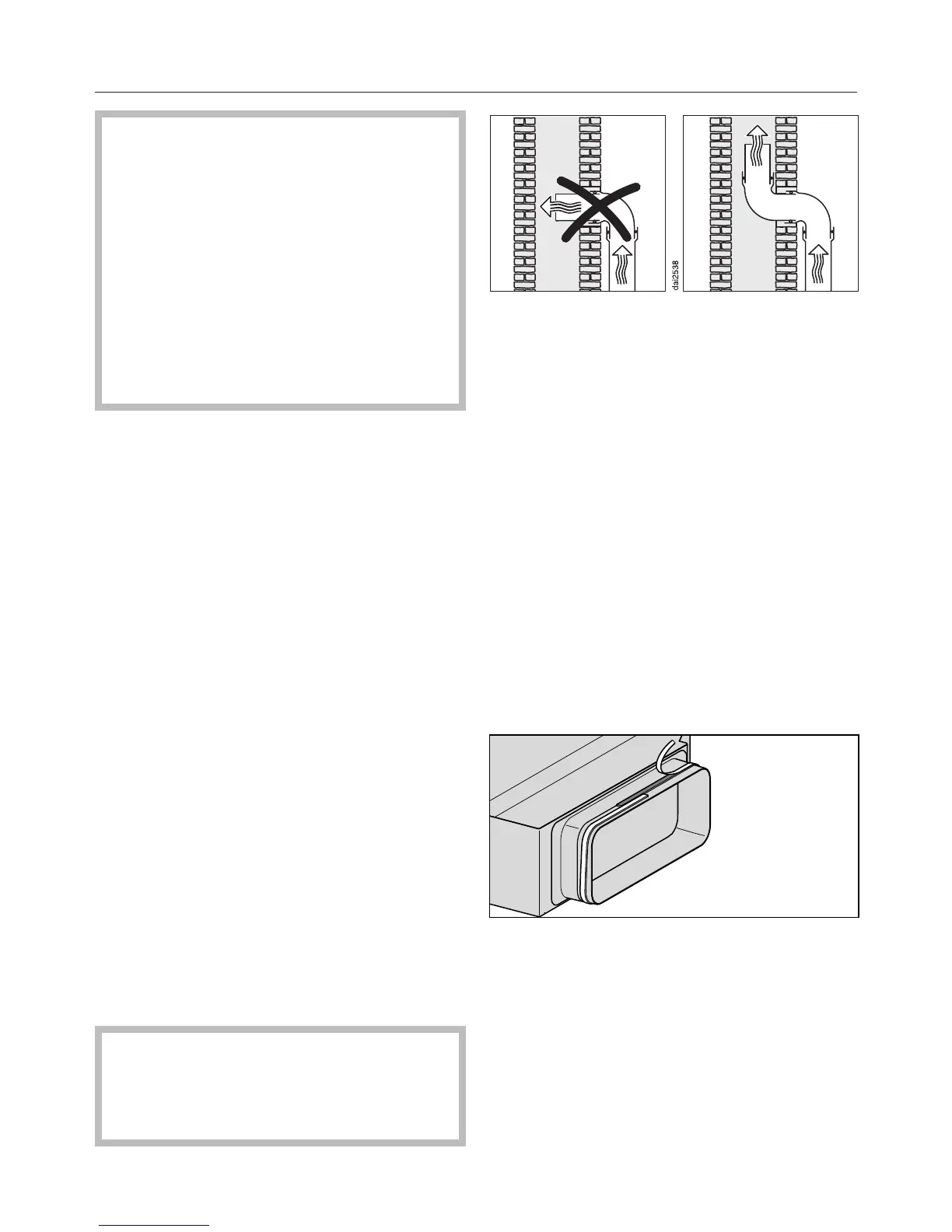
If the exhaust air is to be ducted into
a flue, the ducting must be directed in
the flow direction of the flue.
If ducting is to be laid horizontally, it
must be laid with a downwards
sloping gradient. This is to ensure
that condensate cannot drain back
into the extractor.
If the exhaust ducting is to run
through rooms, ceiling space, etc.
there may be great variations in
temperature between the different
areas. The problem of condensation
will need to be addressed. The
exhaust ducting will need to be
suitably insulated.
Stick the supplied sealing strip on the
exhaust connection if the ducting
does not sit securely up against the
exhaust connection.



 To Next Page