Chapter Five: Theory of Operation General Information
45
Chapter Five: Theory of Operation
General Information
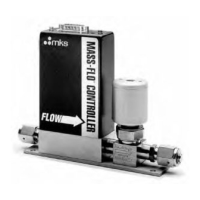
The 1179 Flow Controller measures the mass flow rate of a gas and controls the flow rate
according to a given set point. The control range is from 2 to 100% of Full Scale (F.S.) with an
accuracy of ± 1% of F.S.
Flow Path
Upon entering the flow controller, the gas stream passes first through the metering section of the
instrument for its mass flow to be measured. The gas moves on through the control valve for its
rate of flow to be regulated according to the given set point, and then exits the instrument at the
established rate of flow.
The metering section consists of one of the following:
•
A sensor tube for ranges < 10 sccm (N
2
equivalent)
•
A sensor tube and parallel bypass for ranges > 10 sccm (N
2
equivalent)
The geometry of the sensor tube, in conjunction with the specified full scale flow rate, ensures
fully developed laminar flow in the sensing region. The bypass elements, in those instruments
containing them, are specifically matched to the characteristics of the sensor tube to achieve a
laminar flow splitting ratio which remains constant throughout each range.
Measurement Technique
The flow measurement is based on differential heat transfer between temperature sensing heater
elements which are attached symmetrically to the sensor tube. This senses the thermal mass
movement which is converted to mass flow via the specific heat, C
p
, of the gas. The resulting
signal is amplified to provide a 0 to 5 VDC output which is proportional to mass flow.



 To Next Page
 Loading...