15
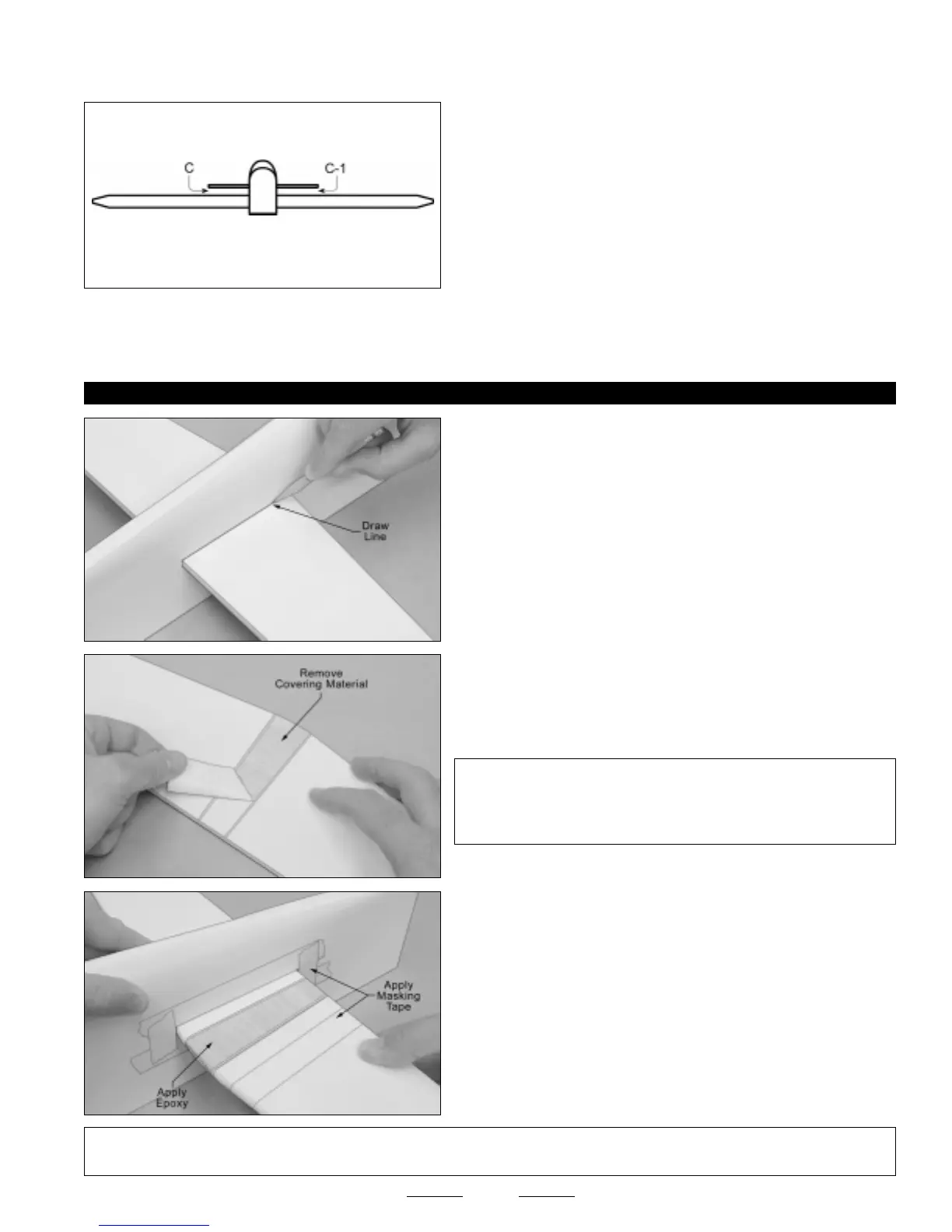
❑ With the stabilizer held firmly in place, look from the front of the
airplane at both the wing and the stabilizer. When aligned properly, the
stabilizer should be parallel to the wing.
☞
If the stabilizer is not parallel to the wing, remove it and use 220 grit sandpaper with a sanding block to sand down the higher
side of the stabilizer mounting slot, then reinstall the stabilizer and check the alignment once more. Repeat this procedure until
you are satisfied with the alignment.
❑ When you're satisfied that the stabilizer is square to the wing, use a pencil to draw a couple of marks on each side of the front
of the stabilizer where it and the fuselage sides meet, then use a couple of T-Pins to hold the stabilizer firmly in place and aligned.
STEP 2: MOUNTING THE HORIZONTAL STABILIZER
❑ When satisfied with the alignment, use a pencil to draw a line on
each side of the stabilizer where it meets the fuselage sides. Do this on
both the top and the bottom.
C=C-1
❑ Remove the stabilizer from the fuselage and use a modeling knife to
carefully cut away and remove the covering material from between the
lines you drew. Do this on both the top and the bottom.
✦✦
✦✦
✦WARNING
✦✦
✦✦
✦ When cutting through the covering to remove it, cut
with only enough pressure to cut through only the covering itself.
Cutting down into the balsa structure could weaken the stabilizer and
cause it to fail during flight.
❑ To make it less messy during installation, apply masking tape to the
fuselage around the side of the mounting slot that the stabilizer will slide
into. Apply masking tape to the top and bottom of the corresponding
side of the stabilizer, too.
❑ Partially slide the stabilizer into the mounting slot.
✦✦
✦✦
✦IMPORTANT
✦✦
✦✦
✦ Because the stabilizer has to slide into place through the fuselage, apply epoxy only to the stabilizer. This will
prevent the epoxy from spreading over the entire length of one half of the stabilizer when you slide it into place.
Continued On Next Page
☛☛
☛☛
☛


 To Next Page