MX
2
Plus Dehumidification system
4 Main components description
NOTE! Some components are optional, and individual systems are built
to
specification.
NOTE! All component pictures are examples, and may not correspond
to
individual
units.
4.1
Dehumidifier
4.1.1
Principle
of
operation
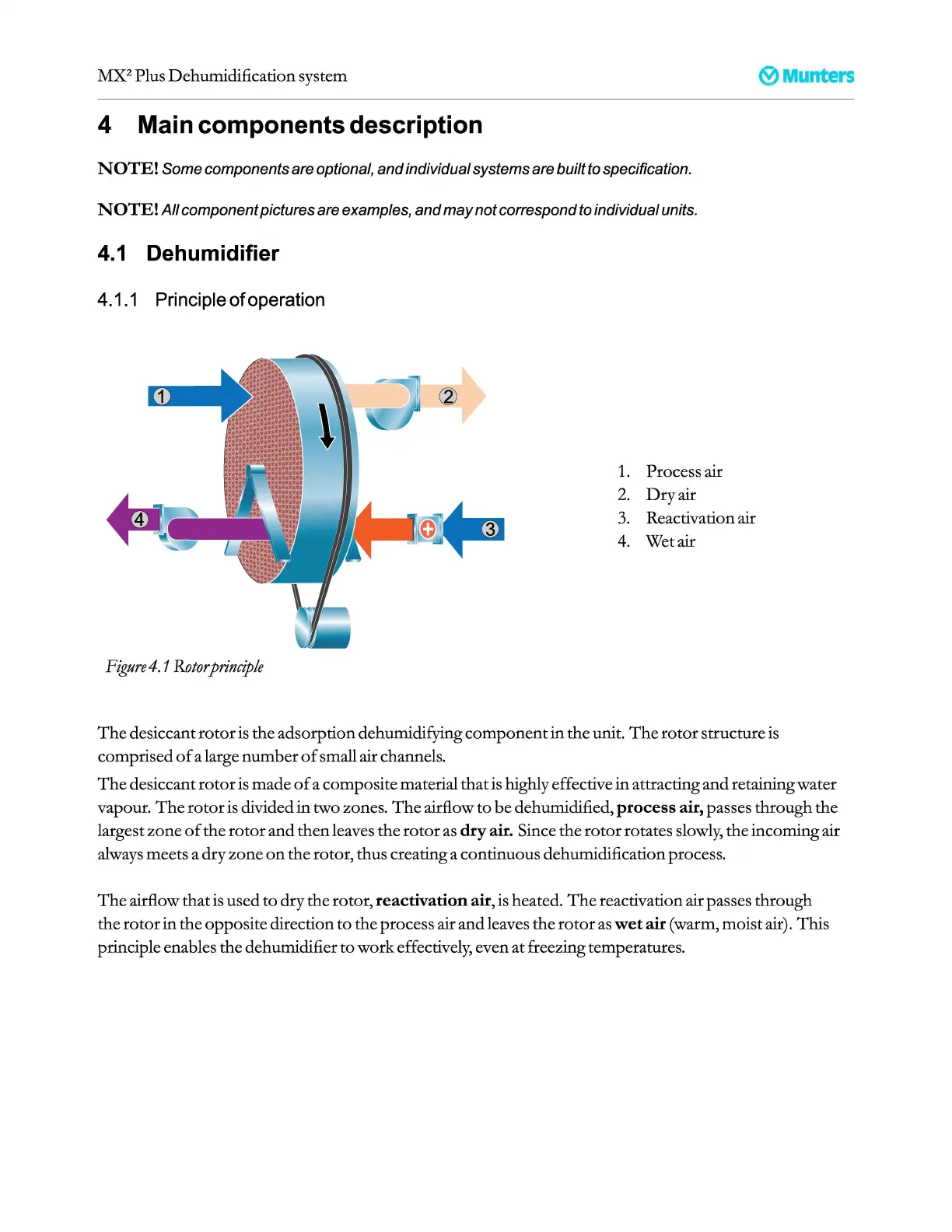
1.
Process air
~
2.
Dry
air
I~
3.
Reactivation air
4.
Wet air
Figure4.1
R!Jtorprinciple
®Munters
The
desiccant
rotor
is the adsorption dehumidifying
component
in the unit.
The
rotor
structure is
comprised
of
a large
number
of
small air channels.
The
desiccant
rotor
is
made
of
a composite material
that
is highly effective in attracting
and
retaining water
vapour.
The
rotor
is divided in two zones.
The
airflow
to
be
dehumidified,
process
air, passes
through
the
largest
zone
of
the
rotor
and
then
leaves the
rotor
as
dry
air.
Since
the
rotor
rotates slowly,
the
incoming air
always meets a dry
zone
on
the
rotor, thus creating a continuous dehumidification process.
The
airflow that is used
to
dry the rotor, reactivation air, is heated.
The
reactivation air passes
through
the
rotor
in
the
opposite direction
to
the
process air
and
leaves
the
rotor
as
wet
air (warm,
moist
air). This
principle enables the dehumidifier
to
work effectively, even
at
freezing temperatures.


 To Next Page