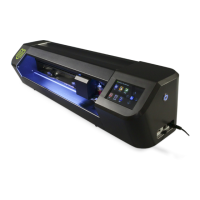
The Muse Artisan is a vinyl cutter designed for precision cutting of various adhesive-backed films and other materials. It is suitable for commercial signs and graphics, as well as personal crafting projects.
Function Description:
The Muse Artisan is primarily used for cutting designs from rolls and sheets of adhesive-backed films such as vinyl, stencil mask, and sandblast etching films. It can also be used with a cutting mat for non-backed materials like paper, cardstock, magnet sheets, and Mylar. The device features a control panel for managing cutting speed, force, and other settings, and can be connected to a computer via USB, Wi-Fi, or a USB flash drive for design transfer and cutting.
Important Technical Specifications:
- Blades: The cutter comes with two types of blades:
- 45° Red Capped Blade: Well-suited for thinner materials like heat transfer vinyl and wall/auto/decal vinyl.
- 60° Blue Capped Blade: Has a longer cutting edge, ideal for thicker materials such as reflective vinyl, some heat transfer film, sandblast stencil, magnet sheets, and light chipboard.
- Connectivity:
- USB Cable: Simple and reliable connection.
- Wi-Fi: Allows for wireless operation within the router's coverage area.
- USB Flash Drive: Enables cutting of .PLT files directly from a thumb drive without a computer connection.
- Control Panel Settings:
- SPEED: Adjustable from 1 to 13, where 1-4 are slow speeds for dense materials, 5-8 are medium speeds for easy-to-cut materials, and 9-13 are fast speeds for larger/simpler shapes.
- FORCE: Adjustable from 1 to 160, representing a maximum of 2000g.
- Blade Offset: Recommended setting is 0.30 mm (or 0.01 in) for ARTisan blades.
- Overcut: Adjustable for precise corner cutting and path closure.
- Software Compatibility: Compatible with LXi 19 (Vinyl Express) and Create Space design software.
- Power: Requires a grounded electrical power source with the correct voltage rating.
Usage Features:
- Pinch Rollers: Individual levers allow for raising and lowering pinch rollers onto the material or cutting mat. Pinch rollers should be centered over the grit rollers, which are marked by white rectangles on the platen. For cutting mats, at least two wheels should be near the outside edges of the mat.
- Test Pen: Used for calibrating the scale and for test drawing. A small piece of wax needs to be removed from the pen's nib before use, and the pen refill may need to be trimmed for easier fit.
- Blade Installation: Blades are inserted into the blade holder. The brass ring is turned counterclockwise to loosen, the blade is inserted (non-sharp end first), and the brass ring is turned clockwise to lock. Blade protrusion should be minimal, only enough to cut through the face film and adhesive, not the release liner. A "Box Test" is recommended to verify proper blade depth.
- Control Panel: Features buttons for RECUT (recuts last job), UDISK (accesses USB drive files), MENU (accesses additional functions like WIFI, Scale, Advance Mode, Language, System), FS (activates SPEED and FORCE adjustment mode), TEST (cuts a small square for setting verification), and PAUSE (pauses/resumes cutting). X and Y buttons move the carriage and grit rollers, respectively, and also adjust SPEED/FORCE in FS mode.
- Origin Setting: The origin is set by manually moving the blade tip to a specific point on the media using the X and Y buttons before cutting.
- Advance Mode: Offers three options for blade holder movement after a cut: return to origin (TO START), advance to top of completed cut (TO END), or advance to the left (TO LEFT).
- Scale Calibration: Allows users to precisely calibrate the cutter's dimensions by drawing a known square and adjusting X and Y Scale values in the MENU.
- Software Integration:
- LXi Production Manager: Users select MUSE as the brand and ARTisan as the model. Connection can be USB (selecting the highest USB_Printer_X option) or Wi-Fi (entering IP Address and Port 8080). Files can be saved as .PLT for USB flash drive use.
- Create Space: Users select MUSE as the brand and ARTisan as the model. Connection can be USB or Wi-Fi. Features include Origin Point or WYSIWYG cut modes, and options to use software speed/pressure settings. Files can be saved as .PLT for USB flash drive use.
- USB Flash Drive Usage: .PLT files saved from design software can be loaded directly onto the ARTisan via the UDISK button on the control panel. Cutting begins immediately upon selecting the file.
Maintenance Features:
- Lubrication: The ARTisan cutters are internally lubricated at the factory and do not require additional oiling or lubrication.
- Cleaning:
- Platen and Blade Holder: Regular dusting with a soft brush is recommended to prevent buildup of dust and material debris.
- Blade Holder: Debris inside the blade holder can be removed using compressed air and a nozzle.
- Pinch Rollers and Grit Rollers: Should be kept clean and free of stickiness to ensure proper material tracking.
- Troubleshooting: The manual provides solutions for common issues such as inconsistent cut quality (adjust speed), poor tracking (proper media loading, checking pinch roller pressure), rough edges (blade protrusion, worn blade), LCD display issues (power, voltage), incomplete cuts (blade holder installation, damaged blade, worn blade holder, software interference), and uneven cut depth (damaged Teflon strip).

 Need help?

 To Next Page
 General