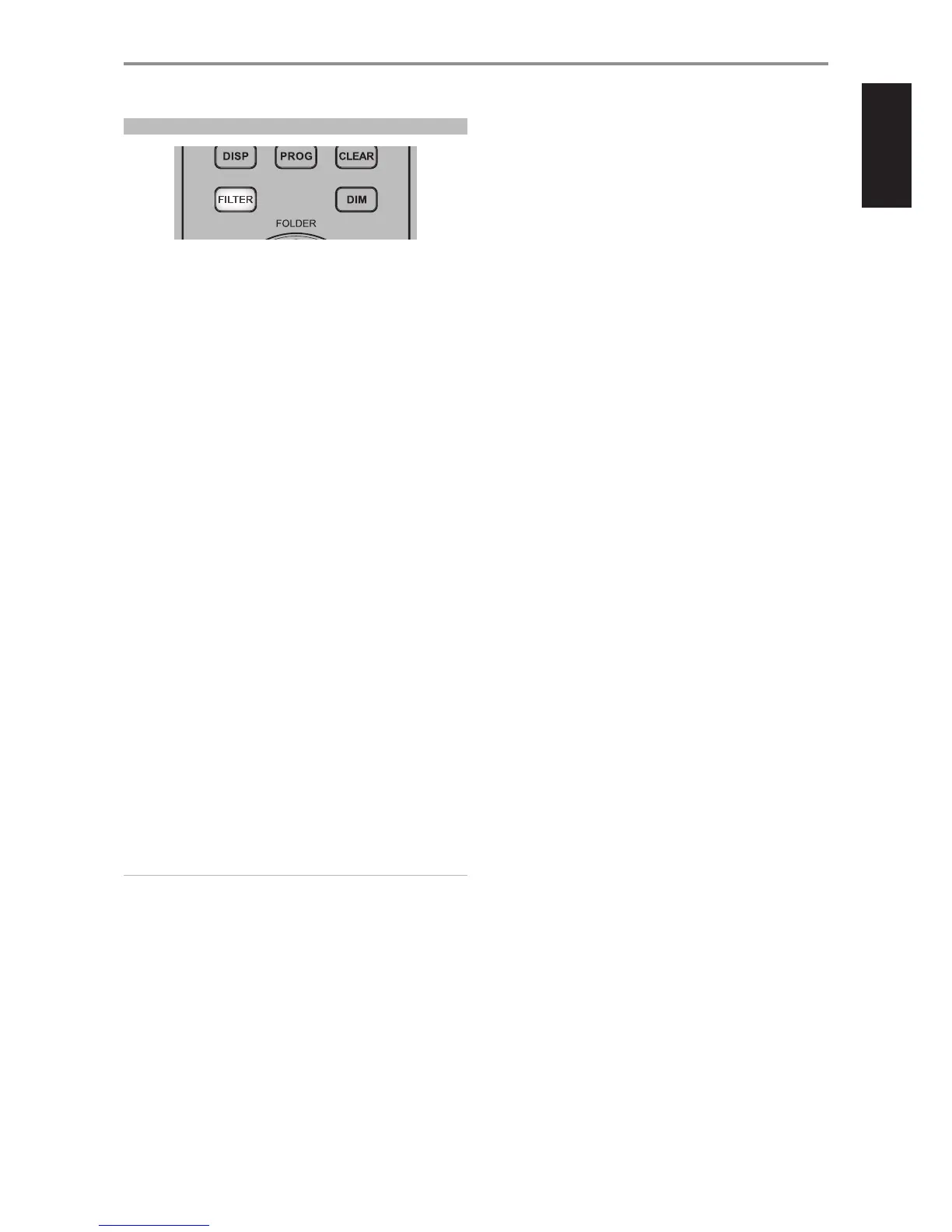
FILTER
The C 568 oers ve unique digital ltering options dedicated to the
achievement of a better audio experience. These selectable lters allow
users the exibility to choose key characteristics that aect frequency
response and time domain characteristics.
Before describing these ve digital lters, please take time to read the
following brief denitions of some of the terminologies used in their
descriptions.
• Passband is the range of frequencies or wavelengths that can pass
through a lter without being attenuated.
• A stopband lter rejects frequencies within a band and letting through
frequencies outside it.
• Group delay is the transit time of a signal through a device versus
frequency.
• Rollo is a term used to describe the steepness or slope of the lter
response in the transition region from the passband to the stopband.
• Ripple refers to uctuations in the passband or stopband of a lter’s
frequency magnitude response curve. It is the periodic oscillation in
the passband near the inection point of the lter (the point where the
passband meets the stopband).
The following is a brief description of each lter’s characteristics. The
selection of lter number is basically a matter of personal choice; tailor
the audio conversion by selecting the lter number that will best suit your
desired listening experience.
Filter 1: Slow roll o lter that has low group delay, low ripple and wide
stopband characteristics.
Filter 2: Medium roll o lter that has high group delay, low ripple and
medium stopband characteristics.
Filter 3: Fast roll o lter that has lower group delay and wider stopband
characteristics.
Filter 4: Medium roll o lter that has higher group delay and narrower
stopband characteristics.
Filter 5: Medium roll o lter that has lower group delay and wider
stopband characteristics.
NOTE
The lter eect applies only to the analog output; it is not applicable to
the digital outputs.
OPERATION
USING THE C 568 CD 9 REMOTE CONTROL
13


 To Next Page