l it has a higher insulation resistance and
l you can make the joints with aluminum tape, which is quicker and cleaner than
glue.
l Use insulation that is at least 5 cm (2.0 in.) thick. Depending on the temperature
stability of the site, additional or thicker boxes can be used.
l Cut a groove at the appropriate point in the bottom of the box to allow the
seismometer cable to exit.
l Seal the box joints properly:
l For rigid foam without a foil coating, glue the joints using polystyrene adhesive
or polyurethane resin, taking care not to leave any gaps.
l For rigid foam with a foil coating, tape the joints with aluminium tape, taking care
not to leave any gaps.
l Ensure there is a good seal between the bottom edge of the box and the pier. Adhesive
weather-stripping that is 1.25cm (0.5 in.) thick creates a good seal.
l Ensure the thermal insulation box is held firmly in place by setting a weight on top of it.
A brick works well for this purpose.
l Strain relieve the cable to the pier, close to the seismometer. Tie-wraps with tie-wrap
anchors or a heavy object are effective tools for achieving strain relief.
3.10 Connecting the Centaur digital recorder and the Trillium
Compact
Use the guidelines in this section to connect the Centaur digital recorder and the Trillium
Compact.
1. Ground the system using the guidelines in "Grounding guidelines " on page89.
2. Power up the digital recorder. You can continue with the steps in this procedure while
the digital recorder is booting up.
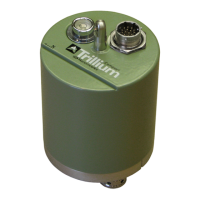
3. Using the appropriate seismometer to digitizer cable, see "Cables and Accessories" on
page12, attach the seismometer connector to the Trillium Compact making sure that
the guides on the cable connector align with the notches on the Trillium Compact.
4. Attach the other end of the cable to the digital recorder, making sure that the guides on
the cable connector align with the notches on the digital recorder
Chapter 3 - Installing a Trillium Compact Vault Seismometer
16889R10 • 2020-11-12 Page 46


 To Next Page