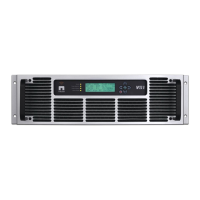
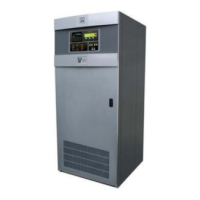
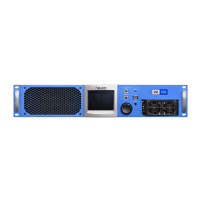
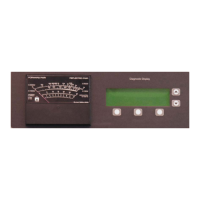
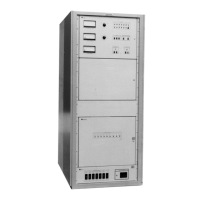
The Nautel VX3 to VX6 is a series of solid-state, VHF, frequency modulated broadcast transmitters designed for FM broadcast applications. This installation manual provides comprehensive instructions for setting up, configuring, and maintaining these transmitters.
Function Description:
The VX3 to VX6 transmitters are designed to broadcast FM signals across the 87.5 - 108 MHz band. They are capable of continuous RF output power, with various models offering different power levels. The transmitter system consists of two main assemblies: an exciter/controller assembly (top) and an amplifier assembly (bottom), typically mounted together in a standard 19-inch cabinet. The exciter/controller assembly handles signal generation and overall system control, while the amplifier assembly boosts the signal to the desired output power. The system supports both local control via a front panel user interface (FPUI) and remote control via an advanced user interface (AUI) accessible through a web browser or SNMP.
Important Technical Specifications:
- Power Output: The series offers a range of power capabilities:
- VX3: Minimum 300 W, Rated 3000 W (Max. 1.5:1 VSWR), Maximum 3300 W (Max. 1.2:1 VSWR)
- VX3.5: Minimum 350 W, Rated 3500 W (Max. 1.5:1 VSWR), Maximum 3850 W (Max. 1.2:1 VSWR)
- VX4: Minimum 400 W, Rated 4000 W (Max. 1.5:1 VSWR), Maximum 4400 W (Max. 1.2:1 VSWR)
- VX5: Minimum 500 W, Rated 5000 W (Max. 1.5:1 VSWR), Maximum 5500 W (Max. 1.2:1 VSWR)
- VX6: Minimum 600 W, Rated 6000 W (Max. 1.5:1 VSWR), Maximum 6300 W (Max. 1.2:1 VSWR)
- Frequency Range: Broadband operation from 87.5 - 108 MHz.
- Output Impedance: Nominal 50 ohm, unbalanced transmission line.
- Antenna Tolerance: Operates at rated power with a VSWR of 1.5:1. Higher VSWR results in protective foldback of output power, with shutdown at 3:1 VSWR.
- Electrical Power:
- Exciter/Controller: 1-phase, 120/240 V ac (90-265 V ac), 130 VA max input power.
- Amplifier: 1 or 3-phase, 208/220/240 V ac (185-265 V ac) or 3-phase, 380 V ac (320-460 V ac).
- VX3: 4.9 kVA max input power, 20.4 A max line current @ 240 V ac, 1-Ph.
- VX3.5: 5.6 kVA max input power, 23.3 A max line current @ 240 V ac, 1-Ph.
- VX4: 6.4 kVA max input power, 26.7 A max line current @ 240 V ac, 1-Ph.
- VX5: 8.2 kVA max input power, 34.2 A max line current @ 240 V ac, 1-Ph.
- VX6: 9.4 kVA max input power, 39.2 A max line current @ 240 V ac, 1-Ph.
- Cooling Requirements:
- Exciter/Controller (fixed fan speed): 30 CFM (51 m³/hr) typical and maximum airflow.
- Amplifier (VX3-VX4) (variable fan speed): 220 CFM (374 m³/hr) typical, 335 CFM (569 m³/hr) maximum.
- Amplifier (VX5/VX6) (variable fan speed): 250 CFM (425 m³/hr) typical, 365 CFM (620 m³/hr) maximum.
- System (VX3-VX4): 250 CFM (425 m³/hr) typical, 365 CFM (620 m³/hr) maximum.
- System (VX5/VX6): 280 CFM (476 m³/hr) typical, 395 CFM (671 m³/hr) maximum.
- Maximum ambient air temperature: 50°C (122°F) at sea level, derated for higher altitudes.
- Input/Output Connections:
- MPX/SCA: Two female BNC connectors (30 Hz to 100 kHz, 10 kohms input impedance).
- Analog Audio: Two 3-pin female XLR connectors (30 Hz to 15 kHz, -12 to +12 dBu, 600 ohms input impedance).
- AES/EBU: Two 3-pin female XLR connectors (32 to 192 kHz sample rates, 110 ohms balanced).
- 10 MHz IN: Female BNC connector (0.5 V to 2 V pk-pk sine wave, 50 ohms input impedance) for GPS reference.
- 1 PPS IN: Female BNC connector (5 V TTL, 10 kohms input impedance) for GPS reference.
- 19 kHz OUT: Female BNC connector (0 to 2.7 V pk-pk adjustable) for pilot signal.
- Remote I/O-A and I/O-B: 9-pin male D-sub connectors for remote inputs and outputs.
- LAN: Ethernet port for web-based AUI control, SNMP, and email server.
- USB: Three USB 2.0 ports for media storage and software upgrades.
- RF Drive Sample: BNC connector for monitoring RF drive level (-44 dB typical).
- External Interlock: Terminal block for external safety interlock circuit.
Usage Features:
- Continuous Power Control: The operator can continuously vary the output power or switch to preset power levels using the remote AUI or front panel UI.
- Remote Control and Monitoring: The transmitter offers extensive remote control and monitoring capabilities via a web-based AUI, SNMP, and email server. This allows for remote adjustment of power, frequency, audio parameters, and monitoring of alarms and status.
- Program Inputs: Supports various audio input types including analog (balanced left/right or monaural), MPX/SCA, and AES/EBU digital audio.
- Carrier Frequency and Pilot Phase Control: Provides precision control using an external GPS reference (10 MHz and 1 PPS inputs).
- Safety Features: Includes electrical hazards warnings, lightning protection, RF hazards, toxic hazards, and other general safety precautions. An external interlock system provides an emergency RF inhibit control.
- Online Documentation: Technical documentation is available online in PDF format, with hyperlinks for easy navigation.
- Nautel Website / Online Resources: Provides access to product manuals, RF Toolkit, FAQs, How-To Videos, and software versions.
- Nautel User Group (NUG): Offers access to product manuals and the RF Toolkit for registered users.
Maintenance Features:
- Technical Support: Nautel offers 24-hour technical support via phone, fax, and email.
- Module Exchange Program: Expedited servicing and replacement of faulty modules with refurbished units to minimize downtime.
- Standard Warranty: Forty-eight months for mechanical and electrical parts, and twelve months for other Nautel manufactured equipment, provided proper installation, operation, and maintenance.
- Extended Warranties: Optional one or two-year plans covering electrical and mechanical repairs or replacements.
- Pre-Installation Consulting: Nautel field support specialists assist with site readiness and planning.
- Installation and Commissioning Service: Nautel technical personnel can assist with AC power, RF, and remote connections, as well as configuration and testing.
- On-Site Support: Field support specialists are available for on-site assistance, scheduling, and pricing.
- Training: SBE-certified broadcast training programs and individual modules are available to enhance technical skills.
- Troubleshooting Manuals: Dedicated manuals (Volume 3, VX Troubleshooting (TRB) Manual) provide detailed information, parts lists, wiring information, electrical schematics, and mechanical drawings for troubleshooting.
- Preventative Maintenance: Regular checks for air flow, cooling, and electrical connections are emphasized to ensure optimal performance and longevity.
- Safety Precautions: Detailed guidelines for personal safety, site safety, and equipment safety, including procedures for handling high voltage, RF hazards, and proper grounding.

 Need help?
 General

 To Next Page