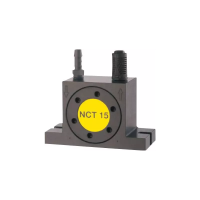
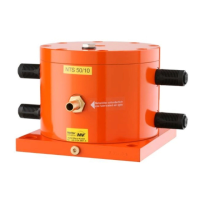
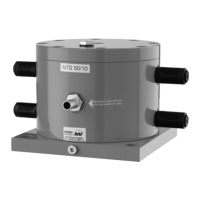
The NetterVibration PKL series comprises pneumatic impactors designed for industrial applications, primarily to dislodge adhesive bulk materials from container walls and facilitate material flow. These devices are often referred to as "pneumatic hammers" due to their operational principle.
Function Description:
The PKL impactors operate by utilizing compressed air to drive a piston against one or two springs. When the air chamber beneath the piston is abruptly emptied via a quick air-exhaust valve, the spring force propels the piston (hammer) against an impact plate. This impact plate then transmits the impact force (F) to the target surface. For models without an impact plate (PKL 190, PKL 450, and PKL 740), the piston strikes directly against the fastening surface. Models PKL 1000, PKL 2100, PKL 5000, and PKL 10000, however, incorporate an impact plate. The exhaust air escapes through a silencer, reducing noise levels.
A key operational feature is that the PKL units only function when mounted. This is because the piston chamber is sealed either by a built-in O-ring in the mounting surface (for PKL up to 740) or by a damper ring (flange; for PKL 1000 and above).
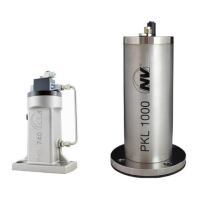
The PKL 740 model distinguishes itself by integrating a quick-air exhaust valve and a 3/2-way valve within its valve head. This design allows the control valve on the customer's site to be mounted at any distance from the PKL 740. The control air is connected at the side, and a silencer is fitted to the exhaust air outlet.
The ST kit, an optional accessory, enables a continuous impact sequence with a permanent compressed air supply. The EE kit, another optional feature, generates a "rubber hammer effect" and contributes to noise reduction.
Important Technical Specifications:
Permissible Operating Conditions:
The PKL units are designed to operate with clean compressed air or nitrogen, preferably oiled, adhering to ISO 8573-1 standards (Filter ≤ 5 µm, Humidity/pressure dew point ≤ +10 °C, Total oil content ≤ 5 mg/m³).
Lubrication:
ISO viscosity class in accordance with DIN ISO 3448, VG 5 to 15, is recommended. The mist lubricator should be filled with acid- and resin-free compressed air oil. For temperatures up to 60 °C, Klüber "AIRPRESS 15" is recommended, while for HT-versions operating over 60 °C, Aral "Farolin U" lubrication oil is suggested.
Ambient Temperature:
Standard models operate between -20 °C and 60 °C. HT versions are designed for -5 °C to 160 °C, depending on the specific version. NT versions are available for low-temperature applications.
Operating Pressure:
The permissible operating pressure ranges from 2.5 to 7.0 bar. It is crucial that the actual air pressure set on the regulator does not exceed the optimum operating pressure by more than 1 bar.
Impact Frequency:
The maximum impact sequence should not exceed 10 strokes in sequence at an impact frequency of 15 strokes/min and 180 strokes/h.
Sound Level:
Near the PKL or connected constructions, the sound pressure level may exceed 80 dB(A). Hearing protection is mandatory in noisy areas if 80 dB(A) is exceeded. Mounting the PKL with an EE kit is recommended as it reduces the sound pressure level by approximately 5 dB(A) (single sound incident). Sound emitted by the PKL can be dampened by coverings, with further reduction achieved by insulating applied sheets.
Dimensions and Weights (Examples):
- PKL 190/4 (4 bar): Weight of piston: 0.19 kg, Force of impact: 0.43 kg, Air consumption: 0.20 NI, Overall weight: 0.8 kg, Suitable for wall thickness: 1-2 mm.
- PKL 740/4 (4 bar): Weight of piston: 0.74 kg, Force of impact: 1.80 kg, Air consumption: 0.70 NI, Overall weight: 2.6 kg, Suitable for wall thickness: 2-4 mm.
- PKL 5000/6 (6 bar): Weight of piston: 4.96 kg, Force of impact: 10.60 kg, Air consumption: 8.60 NI, Overall weight: 16.5 kg, Suitable for wall thickness: 6-12 mm.
- PKL 10000/6 (6 bar): Weight of piston: 10.00 kg, Force of impact: 17.50 kg, Air consumption: 15.10 NI, Overall weight: 34.0 kg, Suitable for wall thickness: > 10 mm.
Usage Features:
Intended Use:
PKL impactors are primarily used for knocking off adhesive bulk materials from container walls (e.g., silos, hoppers, filter outlets, pipelines, and reactors) and for emptying residues from weighing containers. They also prevent bridging and rat-holing, ensuring continuous material flow. The devices can be used outdoors and in dusty or dump environments, but not in water or other liquids. PKL units must be operated with a timed on/off sequence; any other use is considered improper.
Installation:
Installation, commissioning, maintenance, and troubleshooting must only be performed by authorized qualified personnel with basic knowledge in pneumatics and mechanics.
For PKL 190, PKL 450, and PKL 740, the impact piston remains in the housing during installation. For PKL 1000, PKL 2100, PKL 5000, and PKL 10000, an impact plate and two damper rings (flange and impact plate) or an EE kit and a damper ring (flange) are additionally required. Fastening screws must be checked after one hour of operation and monthly thereafter, and retightened if necessary. A safety device with a safety cable is mandatory for critical mounting situations to prevent falling parts.
Fastening Devices:
Appropriate fixing devices (±0.1 mm flatness) include weld-on consoles, weld-on plates, and glueing consoles. Weld-on consoles are attached directly to container walls, while weld-on plates are mounted onto previously installed saddle plates (1.5 times the container's sheet thickness). Glueing consoles are directly glued to container walls. Compulsory fastening kits (NBS) are available for secure and permanent fixation, with options for tapped holes, through-holes, or without screws.
EE Kit Installation:
For PKL 190/450/740, the EE kit is installed between the PKL flange and the mounting surface, ensuring the piston strikes the elastomer disc and the O-ring is between the spacer plate and the mounting surface.
For PKL 1000/2100/5000/10000, the steel impact plate with O-ring and damper ring (impact plate) are removed, and the EE impact plate with O-ring is inserted so the piston strikes it. The damper ring (flange) must be between the PKL flange and the mounting surface.
Compressed Air Supply:
Hose lines must be carefully screwed on and checked regularly. Compressed air must be disconnected during all work on the PKL to prevent accidental activation.
Recommended cross-sections for control lines, control valves, and main air supply are DN 6 × 1. The control valve to PKL connection should use DN 6 and not exceed 15 m in length. For simultaneous operation of several PKL, larger cross-sections are needed for the main line, and the total length of compressed air supplies should not exceed 50 m.
Start-up and Operation:
A ball valve to shut off the main line and a maintenance unit (filter, regulator, mist lubricator) are required for all installations. The mist lubricator should be set to the smallest safely adjustable number of drops while the PKL is running.
Impact frequency for PKL with ST control can be set via a non-return throttle valve. For PKL without ST control, it is regulated by an external control (e.g., a 3/2-way valve and a Netter Electronic Timer AP). Impact force can be reduced by lowering the pressure (except for PKL with ST kit). Throttling the air supply only delays charging time, not impact force.
Maintenance Features:
Maintenance Plan:
Regular maintenance is crucial for optimal performance and longevity.
- After one hour of operation: Check and retighten fastening screws and hose connections.
- Monthly: Check fastening screws, fastening kit NBS, hose connections, hose supply connections for permeability and kinks, silencer function, and impact effect. For mist lubricator installations, ensure proper operation and refill oil. Empty and clean the filter of the maintenance unit.
- At the latest after 500,000 strokes: Perform a general overhaul, replacing all wear parts.
Cleaning:
If performance loss or standstill is observed due to wear film, the piston should be removed, cleaned, and the guide ring and piston seal replaced if necessary, then reinserted. Special tools are available for this process.
Maintenance Intervals:
Maintenance intervals depend on service life and the cleanliness of the drive medium. Unfiltered compressed air can lead to high wear, silencer clogging, or complete failure. NetterVibration offers maintenance, repair, and general overhaul services.
Troubleshooting:
A comprehensive troubleshooting guide is provided for common malfunctions:
- Does not function: Possible causes include non-flat mounting surface (loss of pressure via O-ring), valve/control malfunction, or insufficient compressed air supply. Corrective actions involve establishing flatness, checking/replacing valve/control, and checking/increasing pressure.
- Does not function and has leakage at top: Indicates wear of seals, requiring replacement.
- Does not function and has leakage on mounting surface: Could be due to incorrect mounting or non-flat mounting surface. Corrective actions include tightening fastening screws, establishing flatness, and checking/replacing O-ring.
- Does not function with ST kit: Often due to insufficient operating pressure, requiring checking the PKL model and increasing pressure.
- Impact weak: Possible causes are insufficient compressed air supply, contamination of control valve, contamination of silencer, or wear/leakage. Corrective actions include checking/increasing pressure, cleaning/replacing control valve, cleaning silencer, and replacing seals.
Spare Parts and Accessories:
When ordering spare parts, the required amount, description, position, and PKL type must be provided. Available accessories include NBS fastening sets, ST kits, hose material and connections, way valves, non-return throttle valves, maintenance units, Netter Electronic Timers, fixing devices, sound protection hoods, EE (HT) kits, and safety cables. Special models like PKL E (ATEX area), PKL HT/NT (high/low temperature), and PKL 2100 S/PKL 5000 S (stainless steel) are available on request.
Disposal:
All parts of the PKL must be disposed of according to their material specifications (steel or stainless steel, aluminium, plastics). The valid disposal prices are available on request. Valves and screw connections are made of plastics, brass, and/or aluminium.


 To Next Page
 General