© National Instruments Corporation 41 NI cDAQ-9178/9174 User Guide and Specifications
High Frequency with Two Counters
For high frequency measurements with two counters, you measure one pulse of a known width using
your signal and derive the frequency of your signal from the result.
Note Counter 0 is always paired with Counter 1. Counter 2 is always paired with Counter 3.
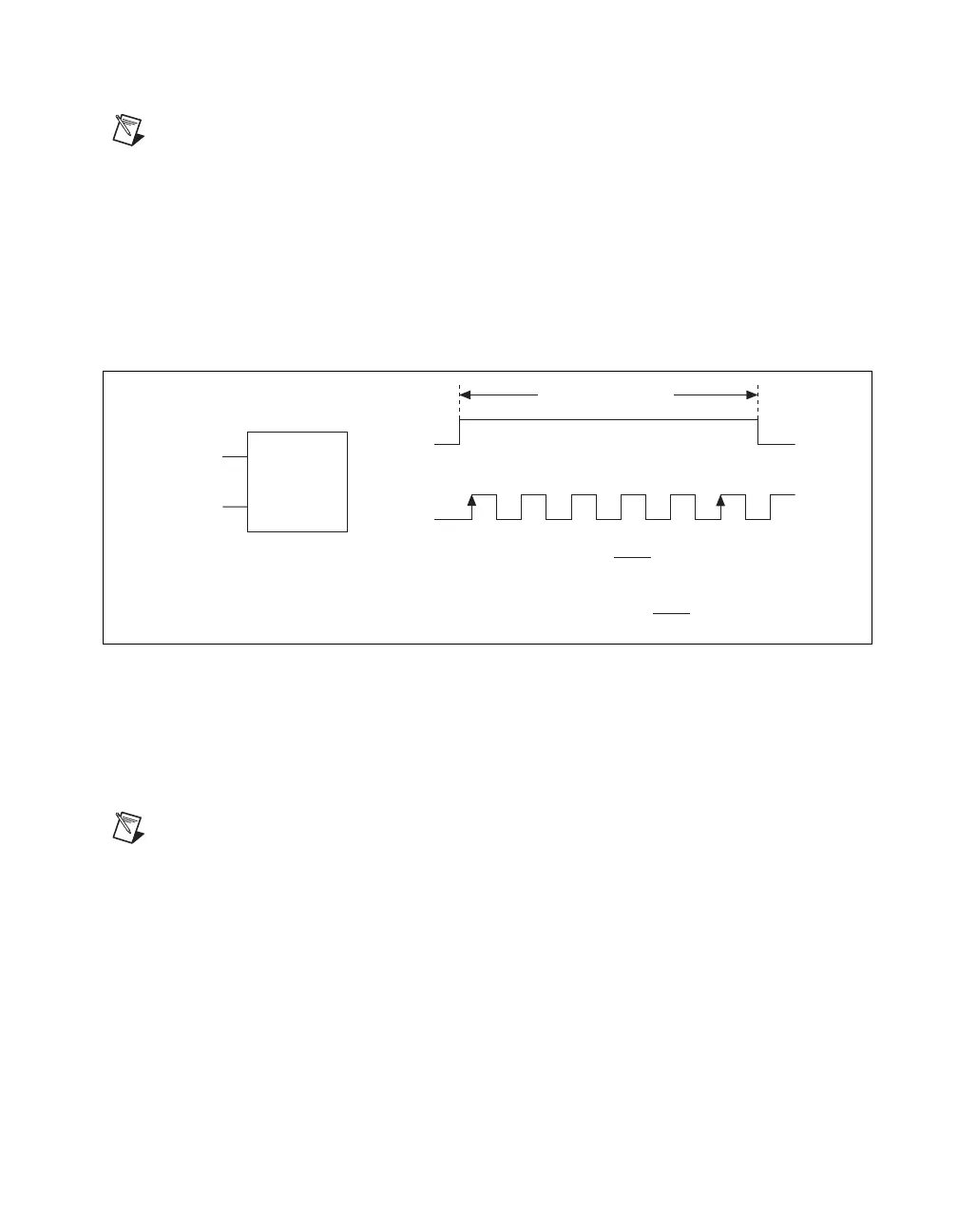
In this method, you route a pulse of known duration (T) to the Gate of a counter. You can generate the
pulse using a second counter. You also can generate the pulse externally and connect it to a PFI terminal.
You only need to use one counter if you generate the pulse externally.
Route the signal to measure (fx) to the Source of the counter. Configure the counter for a single
pulse-width measurement. If you measure the width of pulse T to be N periods of fx, the frequency of
fx is N/T.
Figure 32 illustrates this method. Another option is to measure the width of a known period instead of
a known pulse.
Figure 32. High Frequency with Two Counters
Large Range of Frequencies with Two Counters
By using two counters, you can accurately measure a signal that might be high or low frequency. This
technique is called reciprocal frequency measurement. When measuring a large range of frequencies
with two counters, you generate a long pulse using the signal to measure. You then measure the long
pulse with a known timebase. The NI cDAQ-9178/9174 can measure this long pulse more accurately
than the faster input signal.
Note Counter 0 is always paired with Counter 1. Counter 2 is always paired with Counter 3.
Pulse
fx
Pulse
fx
Gate
Source
12… N
Pulse-Width
Measurement
T =
N
fx
Frequency of fx =
T
Width of
Pulse
N
Width of Pulse (T )


 To Next Page