Nikon D5100 Experience
39
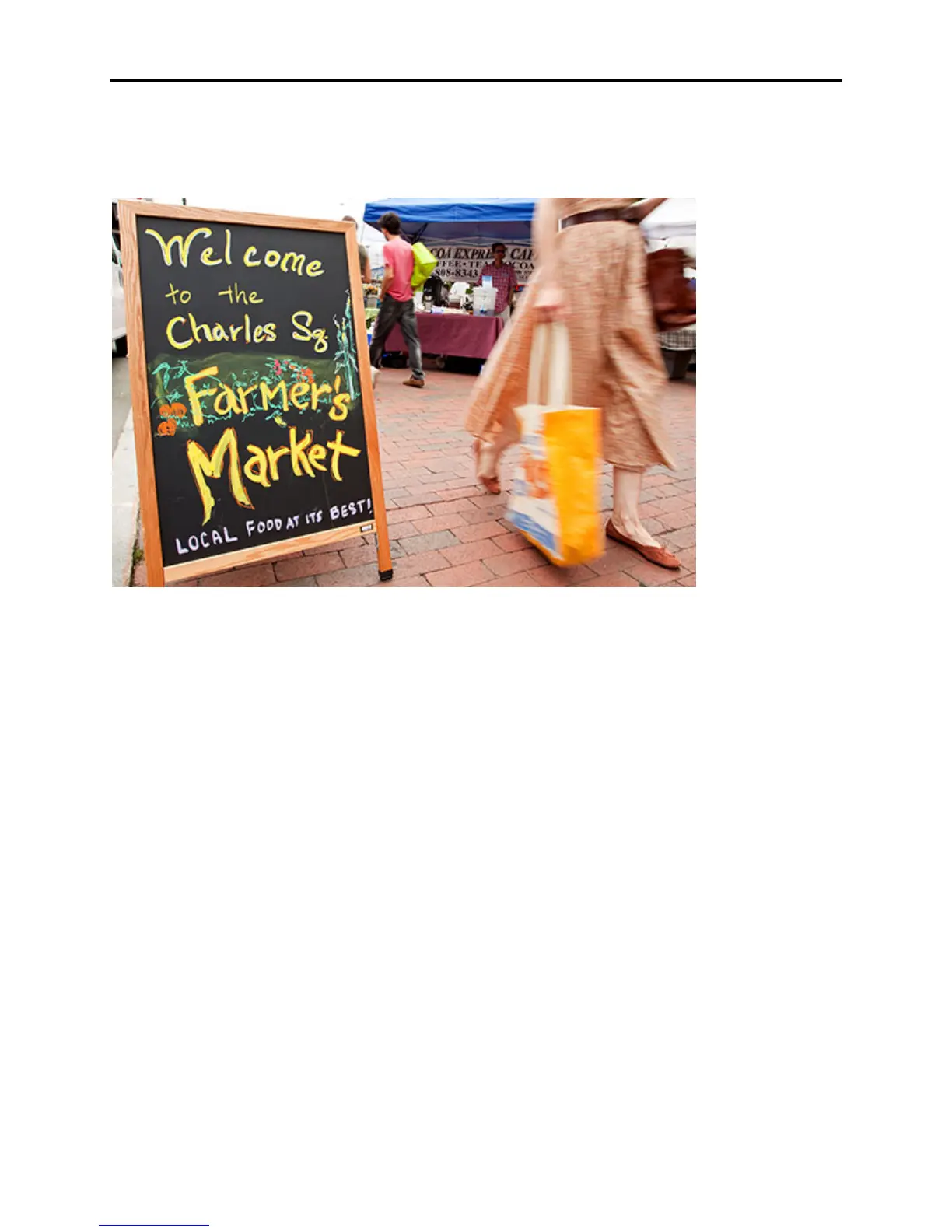
Shutter Speed controls your ability to freeze a moving subject or to let it become a blur across
your frame. A fast shutter speed will freeze the action and a slow shutter speed will cause any
motion to become a blur (see Figure 26).
Figure 26 – Farmer’s Market, Cambridge – A slow shutter speed can express action and
movement (the motion blur of the walking shopper). Shutter speed 1/30, aperture f/13, ISO 100
ISO doesn’t really do anything fun. High ISO settings just cause the image to have more digital
noise, which you typically want to avoid. The D5100 should have an acceptable amount of noise
up to 1600 ISO and possibly very useable images at 3200 ISO. You typically want to use the
lowest ISO possible for the situation, but you will need to change it based on the lighting to
allow for the aperture setting or shutter speed that you wish to use.
Aperture-Priority Auto Mode (A) and Shutter-Priority Auto Mode (S)
Aperture-Priority Auto Mode - A: Many photographers work the majority of the time with their
camera set in Aperture-Priority Auto Mode (A) so that they have full control of the depth of field
(dof) of their images. As will be discussed more in the Composition section, depth of field is
one of the most powerful composition tools available to photographers. Apertures are identified
by numbers such as f/5.6 or f/16. In the viewfinder of your camera and on the Information
Display you will see the number like F5.6 or F16. These numbers often confuse people because
a seemingly “small” aperture number like f/2.8 is a large aperture opening, and a seemingly
“large” aperture number like f/22 is a small aperture opening. But because they are fractions,
f/2.8 really is larger than f/22. 1/3 of a pie is larger than 1/22 of a pie, right? So I will say large
aperture size to mean a large opening (maybe f/2.8 or f/4) and small aperture size to mean a
small opening (maybe f/16 or f/22). A large aperture size will create shallow depth of field



 To Next Page