Need help?
Do you have a question about the Nikon D5000 and is the answer not in the manual?
Crucial safety precautions to prevent injury or product damage.
Guidance on camera help features and online learning resources.
General introduction to the camera and manual structure.
Familiarization with camera components and their functions.
How to access and navigate the camera's settings menus.
Essential procedures for setting up the camera before first use.
Explanation of symbols and conventions used throughout the manual.
Identification and description of the camera's physical parts.
Explanation of shooting modes including P, S, A, M, Auto, and Scene.
Details on viewfinder display, monitor usage, and positioning.
Explanation of the shooting information displayed on the camera monitor.
Instructions for using the command dial and power switch.
Guidance on using automatic shooting modes for simple photography.
How to utilize scene modes for creative photographic effects.
How to view and manage recorded photographs on the camera.
Procedure for removing unwanted images from the camera's memory card.
Step-by-step guide to framing photos using the camera's live view monitor.
Steps to capture video footage using the camera's live view mode.
How to play back and manage captured movie files.
Detailed explanation of autofocus and manual focus options.
How to adjust image file format, compression, and resolution.
Configuration of camera shooting sequences like single, continuous, or timer.
Guide to operating the camera's integrated flash modes.
How to set camera sensitivity to light conditions for optimal exposure.
Setting up automated timed shooting sequences for time-lapse.
How to restore camera settings to default values using a button combination.
Understanding and adjusting shutter speed and aperture for exposure.
Managing camera exposure parameters like metering and compensation.
Controlling color rendition under different lighting conditions.
Capturing multiple exposures to improve results in challenging light.
Adjusting image processing settings for specific looks.
Connecting and using the optional GPS unit for geotagging photos.
Displaying individual photos at full resolution for detailed inspection.
Accessing and interpreting detailed data associated with each photograph.
Alternative methods for browsing multiple images efficiently.
How to magnify images during playback for closer inspection.
Managing image files to prevent accidental deletion and remove unwanted photos.
Accessing and utilizing functions within the playback menu.
How to create and view automated photo slide shows.
Connecting the camera to televisions for image playback.
Connecting the camera to a computer for photo transfer.
Printing images directly from the camera to a PictBridge printer.
Functions available for managing images during playback.
Settings and adjustments for camera shooting functions.
Options for fine-tuning camera behavior to user preferences.
Settings for camera operation, maintenance, and system features.
Tools for editing and enhancing photos directly on the camera.
Creating and managing custom menus for quick access.
Tailoring autofocus behavior, AF-area modes, and live view AF.
Adjusting exposure parameters like EV steps and AE lock.
Configuring self-timer, AE lock behavior, and remote control duration.
Customizing shooting feedback, viewfinder grids, and ISO display.
Adjusting bracketing sequences and built-in flash controls.
Customizing the function of specific camera buttons like Fn and AE-L/AF-L.
Adjusting monitor brightness and information display formats.
Setting the camera's clock, date format, and language.
Configuring auto image rotation and folder management.
Instructions for cleaning the camera's image sensor.
Setting up wireless photo transfer with compatible Eye-Fi cards.
Steps for creating edited versions of photographs on the camera.
Tools for adjusting image shadows, highlights, and red-eye effects.
Cropping images and applying monochrome conversions or filter simulations.
Adjusting color tones and correcting perspective distortion.
Assembling a sequence of photos into a stop-motion video.
Comparing retouched images with their original counterparts.
Choosing between recent settings and user-defined custom menus.
Building a personalized list of frequently used menu options.
Information on compatible lenses, flash units, and other accessories.
Guidelines for cleaning, storing, and maintaining the camera.
Solutions for common camera problems and error messages.
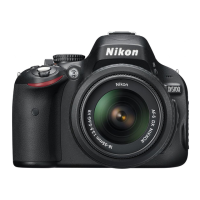
Technical details and specifications of the Nikon D5000 camera.
Expected battery performance and factors affecting battery life.
 General
| Megapixel | 12.3 MP |
|---|---|
| Camera type | SLR Camera Body |
| Sensor type | CMOS |
| Sensor format | DX |
| Image stabilizer | No |
| Total megapixels | 12.9 MP |
| Image sensor size | - \ |
| Image formats supported | JPG, RAW |
| Maximum image resolution | 4288 x 2848 pixels |
| Image sensor size (W x H) | 23.6 x 15.8 mm |
| Still image resolution(s) | 4288 x 2848 3216 x 2136 2144 x 1424 |
| Mounting type | Bayonet |
| Lens mount interface | Nikon F |
| Video recording | Yes |
| Video resolutions | 320 x 216, 640 x 424, 1280 x 720 pixels |
| Motion JPEG frame rate | 24 fps |
| Maximum video resolution | 1280 x 720 pixels |
| Analog signal format system | NTSC |
| Display diagonal | 2.7 \ |
| Display resolution (numeric) | 230000 pixels |
| Magnification | 0.78 x |
| Eye relief | 17.9 mm |
| Scene modes | Beach, Candlelight, Children, Close-up (macro), Dawn, Dusk, Food, Night landscape, Night portrait, Party (indoor), Pet, Portrait, Snow, Sports, Sunset, Landscape (scenery) |
| Image editing | Trimming |
| Photo effects | Black&White, Neutral, Vivid |
| White balance | Auto, Cloudy, Flash, Fluorescent, Incandescent, Manual, Shade, Sunny |
| Playback modes | Zoom |
| Camera playback | Highlights, Movie, Single image, Slide show, Thumbnails |
| Self-timer delay | 2, 5, 10, 20 s |
| Camera file system | DCF 2.0, DPOF, Exif 2.21 |
| Product color | Black |
| Battery life (CIPA standard) | 510 shots |
| Number of batteries supported | 1 |
| Focus adjustment | Auto/Manual |
| Auto Focus (AF) points | 11 |
| Auto focusing (AF) modes | Servo Auto Focus, Single Auto Focus |
| Flash modes | Red-eye reduction, Slow synchronization |
| Flash sync-speed | 1/200 s |
| Flash range (tele) | - m |
| Flash exposure correction | -3EV - +1EV (1/2; 1/3 EV step) |
| Compatible memory cards | SD, SDHC |
| Light metering | Centre-weighted, Matrix, Spot |
| ISO sensitivity | 100, 200, 3200, 6400 |
| Light exposure modes | Aperture priority AE, Auto, Manual, Shutter priority AE |
| ISO sensitivity (max) | 6400 |
| ISO sensitivity (min) | 100 |
| Light exposure correction | ±5EV (1/2; 1/3 EV step) |
| Audio system | Mono |
| Camera shutter type | Electronic |
| Fastest camera shutter speed | 1/4000 s |
| Slowest camera shutter speed | 30 s |
| PictBridge | - |
| USB version | 2.0 |
 Weight and Dimensions
| Depth | 80 mm |
|---|---|
| Width | 127 mm |
| Height | 104 mm |
| Weight | 560 g |

 To Next Page