IV Microscopy (Detailed Procedure)
27
IV
15
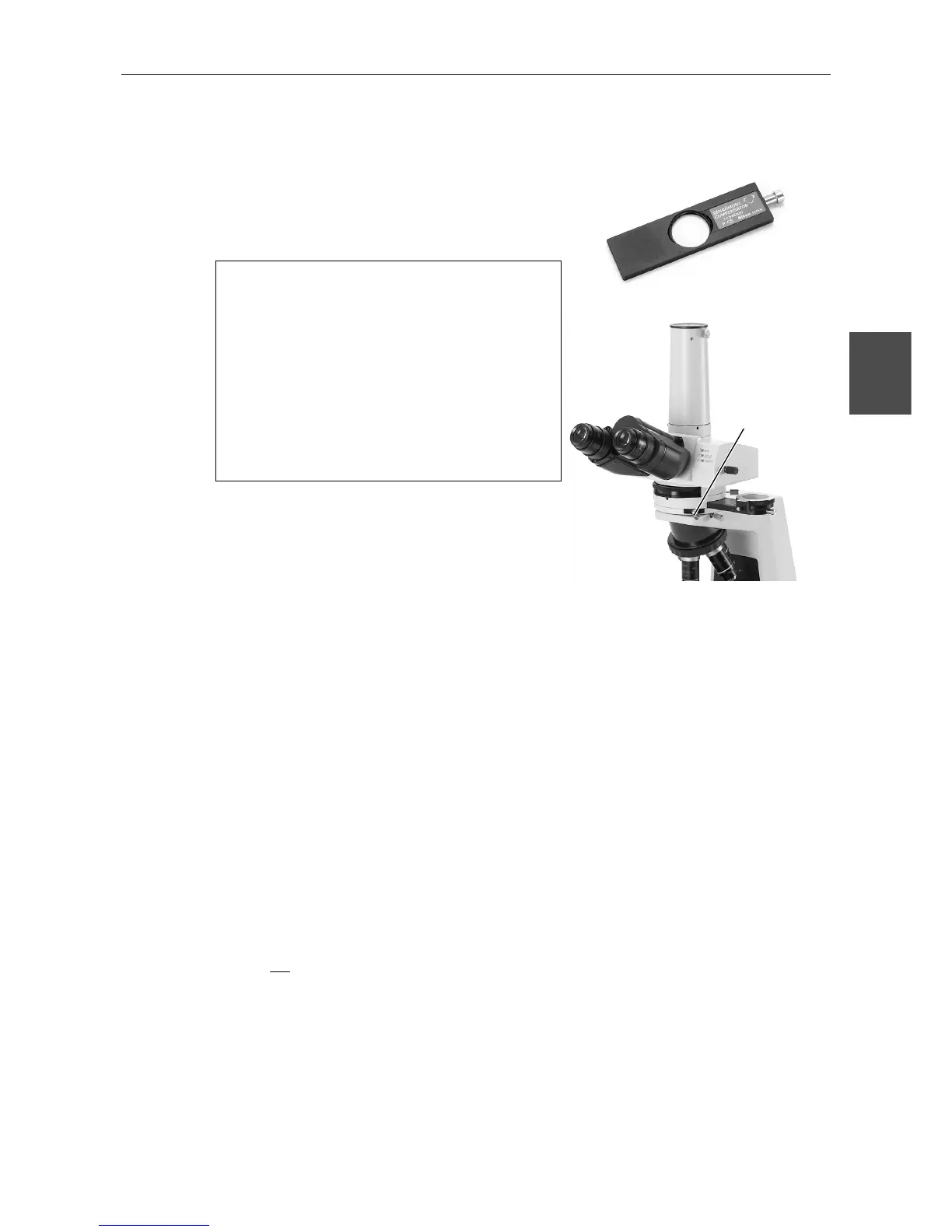
P-CS Sénarmont Compensator
The P-CS Sénarmont compensator is used by
inserting into the slot of the intermediate tube in
place of the P-CL 1/4λ & tint plate.
It can be used to measure retardation up to 1λ
according to the following procedure.
It is normal to bring the top lens of the
condenser into the optical path when
observing at a magnification of 10x or
greater. Measuring the retardation or
evaluating by interference color,
however, stop down the condenser
aperture diaphragm or swing out the
top lens even for a magnification of
10x or higher (with the aperture
diaphragm fully opened), and
illuminate with light that is as parallel
to the optical axis as possible.
(1) Determination of Extinction Position
Rotate the stage with the specimen under the
crossed Nicols to find the direction where the
part of the specimen to be measured appears
darkest.
(2) Determination of Subtraction Position
Rotate the stage 45° from the extinction
position to the diagonal position. Insert the
P-CL 1/4λ & tint plate into the optical path
and confirm that the interference color of the
section of the specimen to be measured
changes toward the lower order side. If the
interference color changes toward the higher
order side, rotate the stage another 90°.
(3) Measurement
Place the GIF filter on the field lens and
replace the P-CL 1/4λ & tint plate with the
P-CS Sénarmont compensator. Rotate the
analyzer so that the section of the specimen
to be measured becomes darkest. When the
rotation angle of the analyzer at that time is
taken to be theta (q) degrees, then
retardation (R) (nm) is determined with the
following formula:
R=
λ
θ
180
( λ : wavelength used)
The value of λ when using the GIF filter is 546 nm.
Insert here






 To Next Page