35
Part 1 - General Safety Information Part 5 - Venting
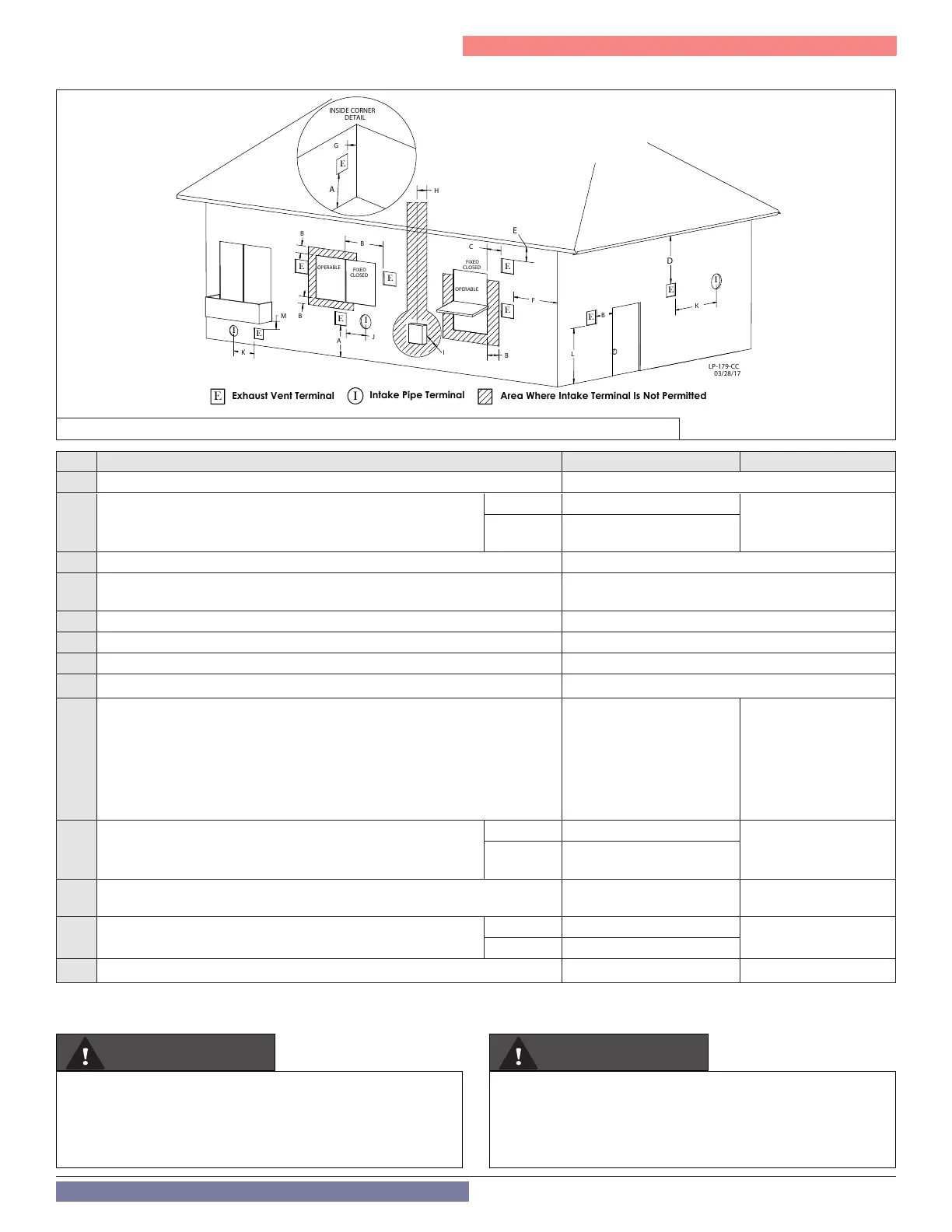
D. Exhaust Vent and Intake Pipe Location
B
H
B
B M
G
E
LP-179-CC
A
FIXED
CLOSED
OPERABLE
I
E
E
E
CLOSED
OPERABLE
FIXED
03/28/17
E
E
D
I
E
E
I
DETAIL
I
INSIDE CORNER
A
B
B
J
L
K
F
C
K
E
E
E
Exhaust Vent Terminal
I
Intake Pipe Terminal
Area Where Intake Terminal Is Not Permitted
DESCRIPTION US CANADA
A Clearance above grade, veranda, porch, deck, or balcony 1 foot (30 cm)
B Clearance to window or door that may be opened
Direct Vent 1 foot
3 feet (91 cm)
Power Vent
4 ft below or to side of
opening; 1 ft above opening
C Clearance to permanently closed window *
D
Vertical clearance to ventilated sot located above the terminal within a hori-
zontal distance 2 feet (61 cm) from the center line of the terminal
*
E Clearance to unventilated sot *
F Clearance to outside corner *
G Clearance to inside corner *
H Clearance to each side of center line extended above meter / regulator assembly *
I Clearance to service regulator vent outlet *
Above a regulator
within 3 feet (91 cm)
horizontally of the
vertical center line of
the regulator vent outlet
to a maximum vertical
distance of 15 ft (4.5 m)
J
Clearance to nonmechanical air supply inlet to building or the
combustion air inlet to any other appliance
Direct Vent 1 foot
3 feet (91 cm)
Power Vent
4 ft below or to side of
opening; 1 ft above opening
K Clearance to mechanical air supply inlet
3 feet above if within 10 feet
horizontally
6 feet (1.83 m)
L
Clearance above paved sidewalk or paved driveway located on
public property
Direct Vent *
7 feet (2.13 m)
Power Vent 7 feet (2.13 m)
M Clearance under veranda, porch deck, or balcony * 1 foot (30 cm)
Table 11 - Vent Termination Clearances - *NOTE: For clearances not specied in ANSI Z223.1 / NFPA 54 for US and CAN/CSA B149.1 for Canada, please use
clearances in accordance with local installation codes and the requirements of the gas supplier.
The building owner is responsible for keeping the exhaust and intake
terminations free of snow, ice, or other potential blockages, as well
as scheduling routing maintenance. Failure to keep the vent piping
terminations clear and properly maintain the heater could result in
property damage, severe personal injury, or death.
For each oor containing bedroom(s), a carbon monoxide detector and
alarm shall be placed in the living area outside the bedrooms, as well as
in the room that houses the heater. Detectors and alarms shall comply
with NFPA 720 (latest edition). Failure to comply with these requirements
could result in product damage, severe personal injury, or death.
WARNING WARNING
Figure 20 - Exit Terminals for Direct Vent Systems - ANSI Z223.1 / NFPA 54 for US and CAN/CSA B149.1 for Canada



 To Next Page